How to Go Viral on LinkedIn: A 2026 Playbook

Most advice on how to go viral on LinkedIn is bad because it treats virality like a writing problem.
It isn't.
A clever hook helps. A personal story helps. Consistency helps. But none of those things explain why one post dies at a few reactions while another breaks out far beyond the author's network. The difference often lies in distribution mechanics in the first window after publishing, plus whether the post is built to trigger conversation instead of passive approval.
That matters even more in B2B. Founders, SDR teams, recruiters, and agencies don't need random attention. They need posts that attract the right buyers, candidates, or partners, then turn that attention into pipeline, trust, and warm outbound opportunities. That's why the strongest playbook combines creative craft with controlled amplification. And if you're scaling, a single-profile mindset becomes a bottleneck fast.
Deconstructing LinkedIn Virality Beyond Luck
The usual advice says to be authentic, post consistently, and hope the algorithm notices.
That advice is incomplete.
LinkedIn virality is less about luck than about engagement velocity, meaning how fast meaningful interaction builds right after a post goes live. According to these LinkedIn virality benchmarks, viral LinkedIn content generates 40 to 50% of its total engagement within the first 2 hours, while average content gets just 20 to 30% in that same window. That's the core mechanic many miss.
Why velocity matters more than quality alone
A strong post that nobody engages with early often stalls.
A slightly less polished post that pulls fast comments, reactions, and shares can spread much further because LinkedIn reads that early activity as a signal that more people should see it. The platform isn't rewarding effort. It's rewarding immediate evidence that people want to join the conversation.
That changes how you should think about content.
Instead of asking, "Is this valuable?" ask:
- Will people stop immediately
- Will they have an opinion
- Will they comment without extra effort
- Will this attract discussion, not just likes
If the answer is no, the post probably won't travel.
Practical rule: Viral posts don't just communicate a point. They create a reason to respond now.
This is also why generic educational posts underperform so often. They may be accurate and useful, but they don't create tension. They don't invite a take. They don't ask readers to reveal anything about themselves.
Virality follows recognizable patterns
Across platforms, breakout content tends to combine timing, emotional clarity, and easy social participation. If you want a cross-platform mental model, this breakdown of what makes a viral video is useful because the same principle applies on LinkedIn. The format changes, but the underlying behavior doesn't. People share and comment on content that makes them feel informed, seen, amused, validated, or challenged.
On LinkedIn, the highest-performing version of that is usually not entertainment for its own sake. It's a professional opinion packaged in a way that feels socially safe to engage with.
What usually fails
Three things kill momentum early:
| Mistake | What happens |
|---|---|
| Writing for approval | People like it and move on |
| Posting without distribution | No early velocity, so reach stays narrow |
| Using vague CTAs | Readers agree, but don't know what to say |
The biggest mindset shift is simple. Stop treating virality as a lottery ticket. Treat it like a launch.
The Anatomy of a Viral Post From Hook to CTA
The post itself still matters. Amplification can't save weak copy forever.
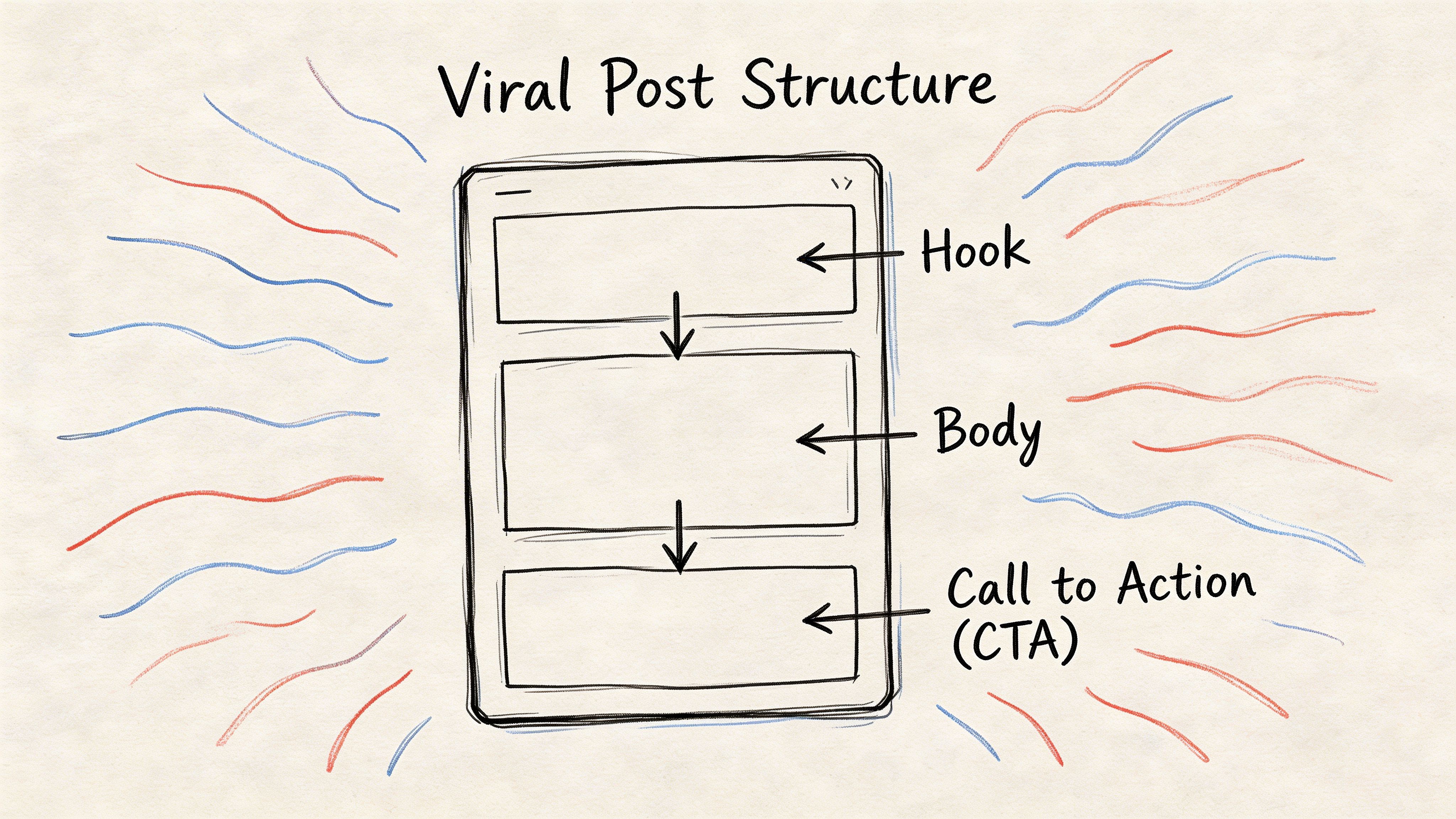
A viral LinkedIn post usually has three jobs. It stops the scroll. It keeps the reader moving. It gives them an easy way to participate.
Start with an asset, not just a post idea
The best-performing B2B posts are often attached to something useful.
That could be a teardown, framework, checklist, hiring rubric, outbound template, research summary, or short explainer video tied to your ICP. The strongest creators don't just publish thoughts. They package value. One framework notes that top creators often feed 20+ viral examples into GPT-4 and use a 15 to 30 second video preview to highlight the value proposition of the asset behind the post, starting with something highly relevant to the ICP in the first place, as described in this 5-step viral post framework.
If you want the basic mechanics of publishing cleanly on the platform before you optimize for reach, this walkthrough on how to make a post on LinkedIn is a good operational reference.
The hook has one job
The hook earns the click to expand.
On LinkedIn, that usually means the first line and often the second. If those lines feel safe, familiar, or self-congratulatory, people keep scrolling.
Hooks that work in B2B tend to fall into a few categories:
Contrarian but defensible
These perform because they create instant tension.
Examples:
- Most SDR LinkedIn content is written for peers, not buyers.
- The problem isn't low reach. It's weak first-hour distribution.
- Founder-led content fails when the founder sounds like a content marketer.
Specific observation
These work when the reader recognizes the problem immediately.
Examples:
- If your post gets likes but no comments, LinkedIn is reading that as weak conversation potential.
- The worst LinkedIn CTA is "Thoughts?"
- Teams ruin good posts by publishing them with no comment plan.
Open loop
This style works when you can pay it off fast.
Examples:
- We changed one part of our LinkedIn launch process and weak posts started traveling further.
- Many individuals blame the algorithm for a problem caused by formatting.
- One comment pattern reliably tells me whether a post can break out.
The hook should create curiosity with control. Confusion doesn't convert.
Build the body for frictionless reading
Most users skim first, then decide whether to commit.
Dense blocks of text lose them. Corporate wording loses them faster. Strong body copy on LinkedIn feels conversational, but it also has structure. Short paragraphs create momentum. White space gives each idea room. The reader should feel pulled downward.
Good body structure often looks like this:
- State the problem clearly
- Add tension or explain why common advice fails
- Give a concrete insight or mini framework
- Support the point with an example
- Transition into a CTA that invites a response
A few practical choices help:
- Use short paragraphs. One to three sentences is enough.
- Cut throat-clearing intros. Start with the claim.
- Prefer concrete nouns. Say founder, SDR, recruiter, carousel, video preview, comment thread.
- Make one point at a time. A post with five ideas usually lands as zero ideas.
Format matters more than writers admit
A readable post has rhythm.
Some lines should feel punchy. Others can carry the explanation. If every paragraph is the same length, the post feels flat even if the ideas are solid.
Here's a simple comparison:
| Weak structure | Better structure |
|---|---|
| Long intro about the importance of LinkedIn | Direct claim tied to a real problem |
| Generic body with broad advice | Narrow point with practical implications |
| CTA asks for engagement vaguely | CTA tells readers exactly what to comment |
Later in the post, richer media can strengthen the asset behind the idea.
Write CTAs that remove decision fatigue
The worst CTA on LinkedIn is the lazy one.
"Thoughts?" produces weak replies because it asks readers to invent a direction. Strong CTAs narrow the response path while still leaving room for opinion.
Examples that usually outperform vague asks:
- Comment guide and I'll send the framework.
- Which one is worse in your industry, weak targeting or weak follow-up?
- Agree or disagree. Founders should own the first comment.
- If you've tested both, which format travels further for you, text-only or video preview?
Each CTA does two things. It lowers friction and increases comment quality.
What works and what doesn't
Below is the practical difference I see most often.
Works
- Opinion with business relevance
- Clear formatting
- A useful asset behind the post
- CTA that tells readers how to engage
- Voice that sounds like an operator, not a brand committee
Doesn't work
- Pure motivation with no point of view
- Long setup before the actual lesson
- Broad educational lists everyone has seen before
- CTA that asks for effort without direction
- Over-polished copy that sounds detached from real work
The post should feel like it came from someone who has done the thing, not someone summarizing what others already said.
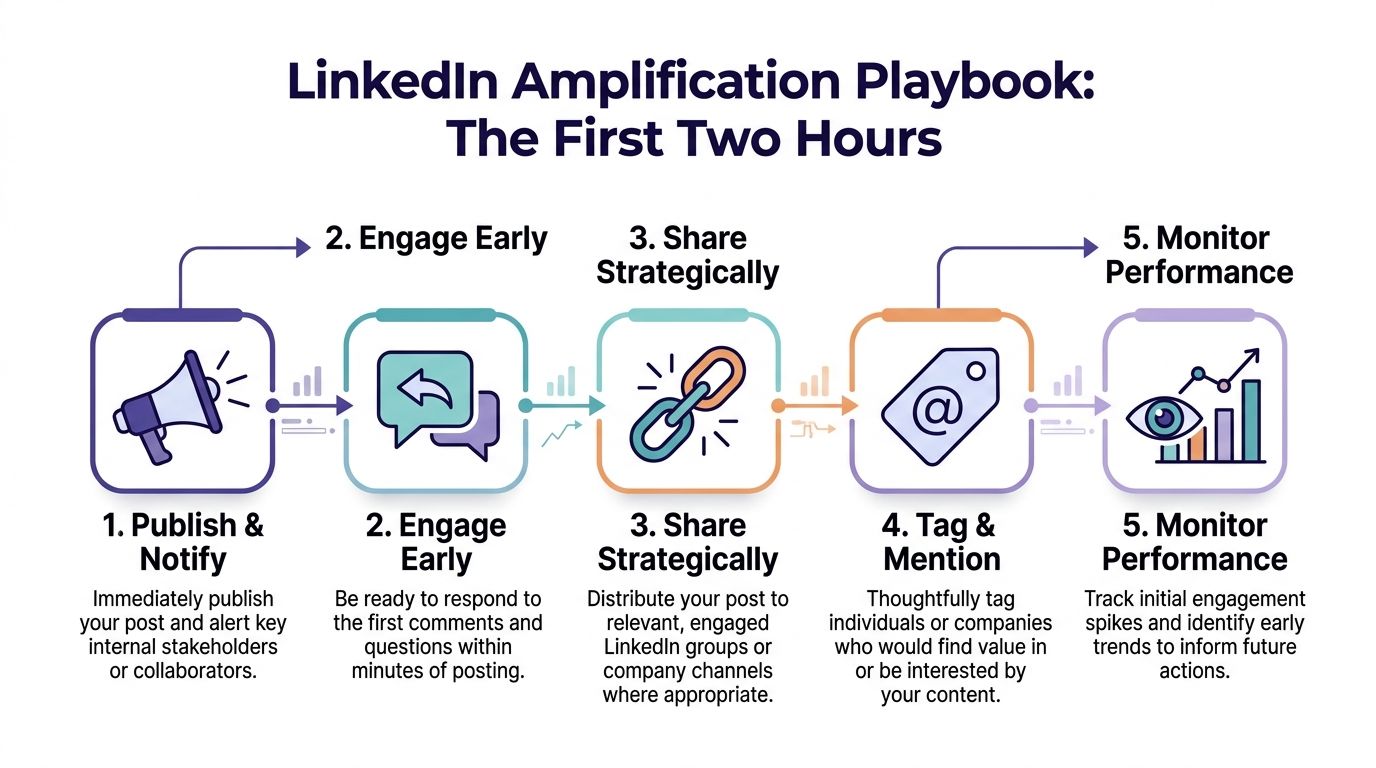
Your Amplification Playbook for the First Two Hours
A post goes live. Many campaigns are won or lost during this period.
People obsess over the writing and then vanish after publishing. That's backwards. The launch window is active work. You need a response plan before you hit publish.
A real-world viral LinkedIn example showed how violent early momentum can be. One post reached over 1 million views and 10,000 likes, averaging 88 likes per hour and 6,700 views per hour on day one, with momentum spikes between 5 and 7 PM EST, according to this breakdown of a viral LinkedIn post trajectory. The lesson isn't that you should chase those exact numbers. It's that early acceleration changes the shape of the entire post.
Minute zero to thirty
At publish, the job isn't done. It's starting.
The teams that do this well don't rely on luck. They know who should see the post first, who can add a meaningful comment, and which conversations they want to trigger. If you're building a repeatable process, this guide to LinkedIn growth hacking is useful for thinking beyond isolated posting.
The first block of time should look like this:
- Publish deliberately. Don't post when you're about to enter a meeting or board a flight. You need attention available for replies.
- Alert relevant allies. Internal stakeholders, friendly customers, colleagues, or creator peers who understand the topic can help start a real conversation.
- Watch the first comments closely. The tone of the comment section forms fast.
- Reply immediately. Quick responses turn one comment into a thread.
This doesn't mean spamming a group chat with "please like my post."
It means giving a small set of relevant people a reason to engage substantively. A good nudge sounds like this: "Just posted a take on founder-led outbound. If you disagree with the comment about lead magnets, jump in. I think your view would help."
A good first hour looks like dialogue
LinkedIn rewards conversation, not just reaction volume.
That means your comment section needs movement. A flat stream of "great post" replies doesn't create much depth. A thread where people disagree, add examples, ask questions, and get answered has much more surface area for distribution.
A simple first-hour checklist:
| Time window | Action |
|---|---|
| Right after posting | Send direct nudges to a small relevant network |
| As first comments arrive | Reply fast with substance, not emojis only |
| If someone adds a strong point | Ask a follow-up to deepen the thread |
| If the post starts spreading | Stay present and keep the conversation moving |
Your first-hour replies should expand the discussion, not close it.
Bad reply:
"Thanks."
Better reply:
"That's fair. I find many teams confuse visibility with buyer relevance. Have you seen the same thing in recruiting content?"
The second version gives the commenter and everyone else a reason to continue.
Sharing strategically without looking desperate
Some amplification methods help. Others cheapen the post.
Good distribution usually includes:
- Direct messages to relevant contacts
- Internal company channels where teammates can join with real perspective
- Selective tagging when a person is directly relevant
- Cross-functional participation from sales, marketing, recruiting, or leadership if the topic touches their domain
Weak distribution usually includes:
- Mass tagging
- Asking for generic engagement
- Dumping the post into irrelevant groups
- Using pod-style comments that all sound the same
That last one is especially damaging. Artificial engagement often creates low-quality comment threads that look manufactured. Even when the post gets surface activity, the discussion feels dead.
What to do in the second hour
By this point, you want to diagnose the shape of the post.
If the post is getting reactions but almost no comments, your CTA or topic likely didn't create enough opinion. If comments are coming in but they're all low intent, your hook may have overpromised and attracted the wrong audience. If quality people are entering the thread with their own examples, you may have a live one.
A few smart moves in the second hour:
- Promote strong commenters by replying in a way that surfaces their expertise
- Add one clarifying comment from the author if a key point needs emphasis
- Avoid editing the main post unless there's a serious error
- Keep answering until the thread can sustain itself
The first two hours are not a vanity ritual. They're a distribution sprint. If you treat them casually, even strong content will underperform.
Measuring What Matters and Iterating on Winners
Many operators look at impressions first.
That isn't useless, but it also isn't enough. A post can rack up reach and still fail as a growth asset. What matters is whether the pattern inside the performance tells you the post can be repeated and whether the attention converted into anything useful.
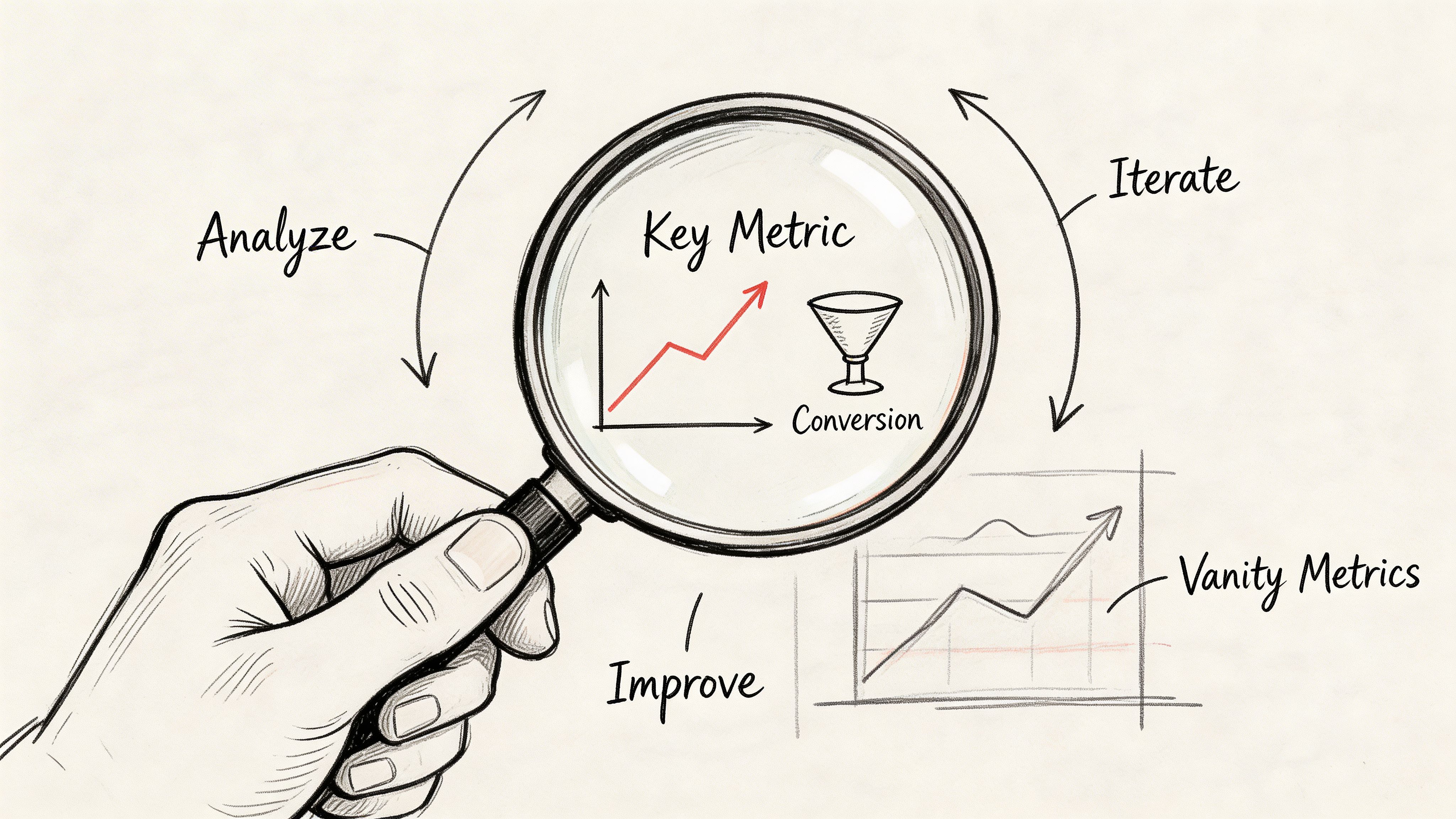
Look past vanity metrics
The strongest operators read LinkedIn performance like a diagnostic panel.
One framework uses a viral coefficient, calculated as k = (i x c x cr x p), where invites, clicks, conversions, and propagation work together to show whether a post can sustain growth. The same analysis notes that high-performing posts with 8 to 12% engagement rates have reached 133K impressions, driven a 3,600% spike, and produced 6% follower growth plus 110 newsletter subscribers in one campaign, as described in this viral LinkedIn GTM framework.
That matters because it connects content performance to business outcomes.
The metrics that deserve attention
Not every useful signal lives in one dashboard tile.
Focus on the metrics that explain behavior:
- Comment quality. Are people adding perspective, or just applauding?
- Comment depth. Are threads continuing beyond the first reply?
- Audience fit. Are the right buyers, operators, or candidates engaging?
- Profile-view spillover. Does the post make people want to learn who you are?
- Conversion path. Are readers taking the next step you intended?
A post that attracts shallow agreement can inflate your ego while teaching you nothing. A post that brings the right people into discussion gives you pattern data you can use again.
Build a simple iteration loop
After every strong post, review it like a campaign.
Keep a winner log
Track:
- Hook type
- Topic angle
- Formatting style
- CTA structure
- Who engaged early
- What business action followed
Separate format from premise
Sometimes the topic wins. Sometimes the structure wins.
A practical review question is: if you swapped the hook but kept the topic, would it still travel? If yes, the premise is strong. If not, the packaging carried it.
The goal isn't one viral post. The goal is knowing why that post worked.
Double down on reusable patterns
The best repeatable winners often come from:
- operational breakdowns
- strong but defensible opinions
- mistakes teams keep making
- frameworks tied to a specific ICP problem
What you want is not "post more of the same." What you want is "extract the mechanics and rebuild them on adjacent topics."
That discipline is what turns a lucky hit into a system.
Scaling Virality with Multi-Account Outreach
Single-profile advice breaks the moment a serious B2B team tries to scale.
A founder can post. A recruiter can post. A sales leader can comment. That works up to a point. Then the bottleneck appears. One account can only create so much reach, enter so many conversations, and support so much outbound activity without becoming fragile.
That's why multi-account strategy matters.
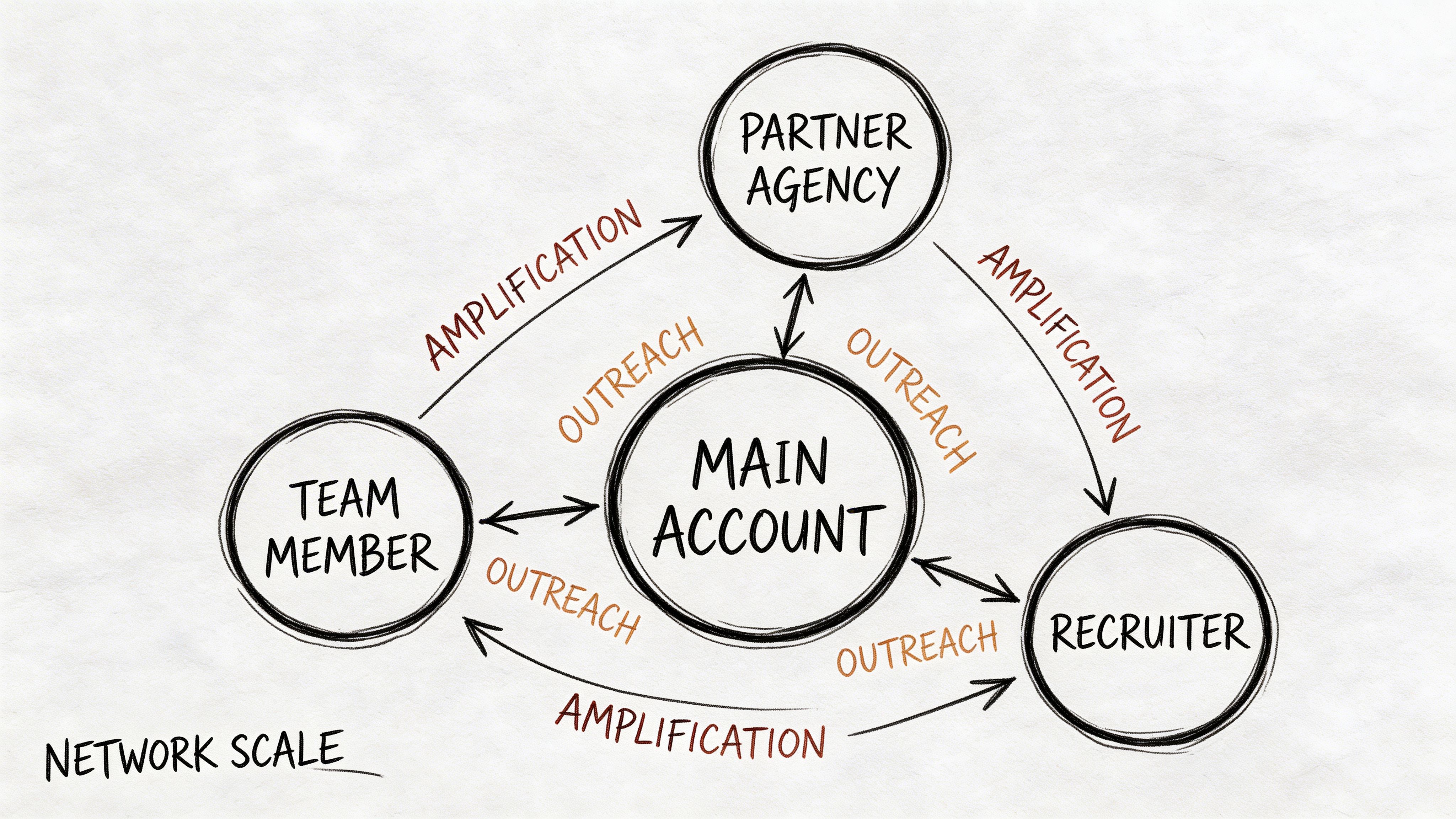
Why one profile isn't enough
Much content about how to go viral on LinkedIn assumes a solo creator model.
That ignores how B2B distribution often works. Agencies run campaigns across clients. SDR teams need multiple surfaces for outreach. Recruiting teams need niche-specific credibility. Founder-led brands need protection around the primary profile while still pushing volume through the system.
An underserved angle in the market is scaling virality across multiple verified accounts. One analysis notes that most guides ignore teams using high-volume automation, even though aged, ID-verified accounts with 200 to 500+ connections are necessary for safer higher-limit activity in these workflows, as covered in this piece on founder-led LinkedIn strategy.
What a multi-account system does
Used correctly, multiple accounts don't just amplify one post.
They let you build a distributed attention layer around a brand or campaign. Different profiles can occupy different roles:
| Account type | Best use |
|---|---|
| Founder profile | Core opinions, authority, category narrative |
| SDR profiles | Comment-layer distribution, network expansion, outbound adjacency |
| Recruiter profiles | Talent-market visibility, role-specific engagement |
| Agency operator profiles | Client amplification, niche testing, cross-account learning |
This works best when each account has a coherent identity.
Don't run ten accounts that all sound cloned. LinkedIn is built around trust and behavioral consistency. One account should consistently talk sales process. Another should focus on hiring. Another can own demand gen or RevOps. That topic coherence makes the network behavior look natural because it is natural.
For teams trying to maintain output without flattening their voice into generic AI sludge, advanced AI content tools can help with ideation, repurposing, and draft variation. They work best when operators still control the angle, examples, and final opinion.
Safety-first execution
Many teams get sloppy at this point.
A multi-account strategy fails when people treat accounts as disposable. They log in carelessly, automate too aggressively, overlap behavior, and blur personal positioning. Then they wonder why reach weakens or restrictions appear.
If you're evaluating the operational side of running more than one profile, this guide on LinkedIn two profiles covers practical setup considerations.
A safer framework looks like this:
- Use separate browser environments so sessions don't bleed together
- Match account behavior to account identity so posting and engagement patterns stay coherent
- Warm up activity gradually instead of going from silent to hyperactive
- Mix native behavior with tooling so automation supports the workflow instead of replacing judgment
- Protect the flagship profile by letting supporting accounts handle broader distribution and testing
Multi-account outreach works when each profile behaves like a real professional with a clear lane.
What works and what backfires
Good multi-account distribution:
- a founder posts a strong opinion
- SDR and recruiting profiles join with relevant perspectives
- niche accounts pull the post into adjacent conversations
- outreach references the live discussion naturally
Bad multi-account distribution:
- all accounts react at once
- comments sound templated
- every profile posts the same take
- automation volume outruns human review
The first approach compounds authority. The second looks synthetic.
For agencies and outbound teams, this represents a significant upgrade. Not more posting. More controlled surfaces for relevance, reach, and follow-up.
Your Questions on LinkedIn Virality Answered
Can you go viral with a small or newer account
Yes, but the bar is higher.
A smaller account has less margin for weak distribution, so the post needs a sharper hook, a clearer opinion, and immediate support from a relevant network. Newer accounts should focus on building comment-side visibility first. Join conversations in your niche, earn recognition, then publish posts that match the same themes.
What should you do if a post gets no traction
Don't immediately conclude the idea was bad.
First, check the likely failure point. If nobody clicked into the post, the hook probably missed. If people reacted but didn't comment, the premise may have lacked tension or the CTA was too vague. If the post was strong but distribution was weak, fix the launch process before rewriting your whole content strategy.
A dead post is often a diagnostic gift if you review it with candor.
Should you chase virality or just post consistently
Both matter, but they serve different jobs.
Consistent content builds familiarity and trust. Viral-style posts create breakout moments that expand your audience beyond the people who already know you. The mistake is building a calendar full of safe posts with no capacity for spread, or chasing shock value so hard that your content stops sounding relevant to your business.
The better approach is a mix:
- steady posts that reinforce your expertise
- occasional high-conviction posts designed for wider conversation
- a follow-up system that captures attention after a breakout
If you do that well, virality becomes a growth lever instead of a vanity event.
If your team wants to scale LinkedIn reach beyond a single profile, BIDVA provides real, ID-verified, warmed-up LinkedIn accounts built for agencies, SDR teams, recruiters, and growth operators who need safer multi-account outreach. You get full ownership, practical setup guidance, and account inventory designed for high-volume campaigns without treating your main profile like a test environment.