10 LinkedIn Growth Hacking Strategies That Actually Work in 2026


The old playbook of generic connection requests and spammy DMs is officially dead. Achieving scalable, predictable growth on LinkedIn now requires a smarter, more systematic approach. This isn't about finding a single 'magic bullet' but about deploying a stack of precise tactics that work in tandem to build authority, warm up cold audiences, and convert connections into customers, all while staying under the platform's increasingly watchful eye.
This guide moves beyond the basics, offering a roundup of 10 battle-tested linkedin growth hacking strategies designed for B2B teams using automation. We will break down each tactic with actionable steps, safety protocols, and real-world examples, showing you how to build a powerful lead-generation machine that compounds over time. You will learn not just what to do, but how to do it safely and effectively at scale.
We'll cover everything from multi-account outreach with identity-verified profiles to AI-powered personalization and strategic comment jacking. Each item is presented as a crucial component of a larger system. To truly unlock exponential growth and scale your pipeline, it's vital to explore a range of effective LinkedIn marketing tactics. This list provides the specific, high-impact methods that form the foundation of that system. Get ready to learn the new rules of engagement.
1. Multi-Account Outreach with Warmed Profiles
The core principle of this LinkedIn growth hacking strategy is to operate multiple, fully developed LinkedIn accounts in parallel. Instead of pushing one account to its absolute limit, this method distributes outreach activities across several profiles. This approach allows teams to multiply their daily touchpoints-connection requests, messages, and profile views-while keeping each account well below LinkedIn's detection thresholds.
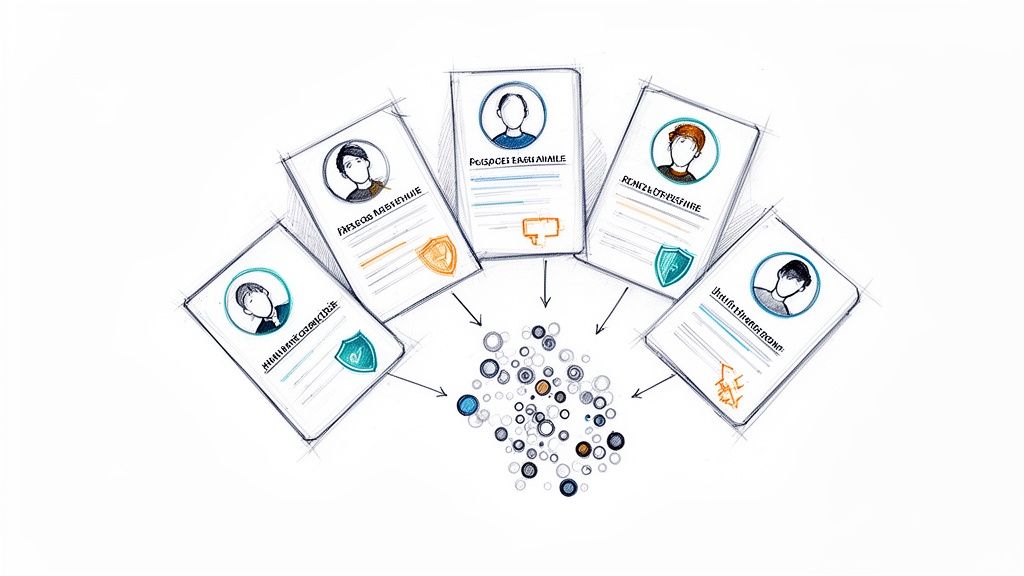
The system works because each account has its own independent trust score, connection limits, and activity history. By using aged, warmed-up, and ID-verified accounts (often called BIDVA), you bypass the initial "sandbox" period for new profiles, enabling safer and more immediate scaling. A B2B sales team, for instance, can run five dedicated accounts for different buyer personas, collectively sending 1,000 personalized messages daily without risking their primary profiles.
Why This Method is Effective
- Scale & Volume: Drastically increases the total number of prospects you can contact daily.
- Risk Mitigation: Spreads activity across multiple profiles, reducing the risk of any single account getting restricted. If one account is flagged, your entire operation doesn't shut down.
- Persona Targeting: Allows you to create distinct profiles tailored to different industries, roles, or verticals, improving message resonance and connection acceptance rates.
Actionable Implementation Steps
- Acquire Warmed Accounts: Secure aged, ID-verified profiles to ensure a high trust score from the start.
- Isolate Your Environment: Use unique browser profiles (like Chrome profiles) and residential proxies for each account to prevent LinkedIn from linking them. You can find detailed instructions on how to manage multiple LinkedIn accounts from one device to avoid common pitfalls.
- Customize Each Profile: Tailor each account's headline, summary, and experience to a specific buyer persona. This makes your outreach feel more authentic and relevant.
- Gradual Ramp-Up: Start with low activity (10-15 connections/day) for the first week and slowly increase volume as the account's Social Selling Index (SSI) score improves.
- Stagger All Actions: Avoid running automation tools on all accounts simultaneously. Schedule outreach campaigns at different times throughout the day to mimic natural human behavior.
2. AI-Powered Hyper-Personalized Message Sequences
This LinkedIn growth hacking technique moves beyond generic templates by using AI to generate unique, prospect-specific messages at scale. The process involves feeding an AI model, like GPT-4 or Claude, with data scraped from a prospect's LinkedIn profile-such as their recent posts, job title, company news, and shared connections. The AI then crafts contextually relevant opening lines, value propositions, and calls to action that resonate on a one-to-one level.
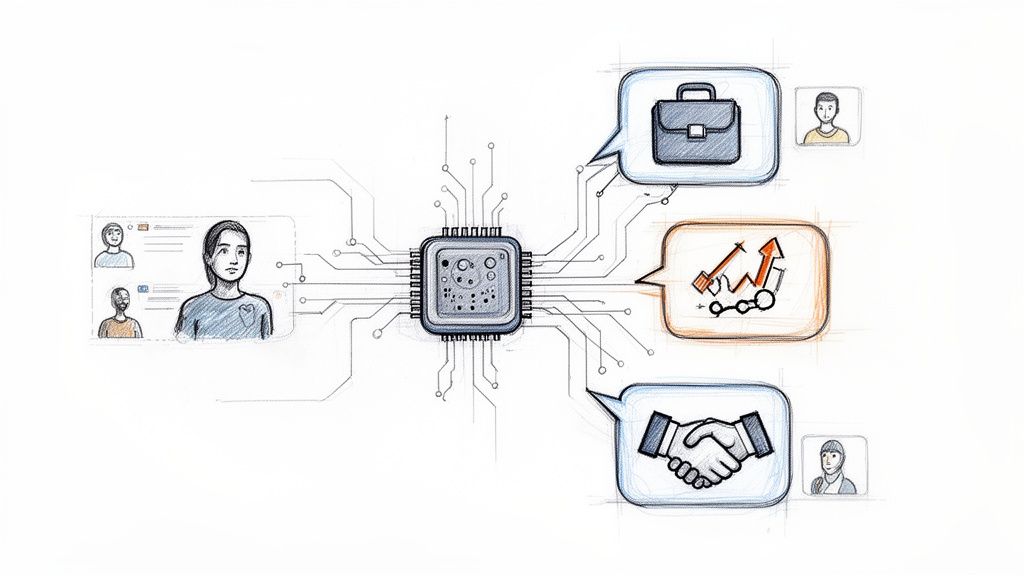
The system works because it automates the most time-consuming part of outreach: research and personalization. Instead of manually searching for a unique angle for each prospect, a sales team can generate hundreds of distinct messages daily that reference specific triggers, like a company's recent funding round or a new product launch. For example, a SaaS growth team can reference specific industry use cases, leading to a 25% increase in booked demos by making the outreach immediately relevant.
Why This Method is Effective
- Deeper Personalization: Goes beyond simple
{{first_name}}and{{company_name}}fields to reference specific, timely events, posts, or professional achievements. - Increased Response Rates: Messages that demonstrate genuine research and relevance stand out in a crowded inbox, significantly boosting replies. Sales teams have seen response rates jump from 8% to over 18% with this method.
- Efficiency at Scale: Preserves the authenticity of manual outreach while operating at the speed of automation, allowing teams to contact more high-value prospects effectively.
Actionable Implementation Steps
- Enrich Prospect Data: Before prompting the AI, use tools like Hunter.io or RocketReach to gather additional data points that can serve as personalization hooks.
- Develop Prompt Templates: Create structured prompts for your AI model. Include specific instructions to generate messages based on triggers like job changes, content engagement, or company hiring announcements.
- Combine AI with Dynamic Placeholders: Use the AI-generated text for the opening line or a specific P.S. note, and combine it with standard dynamic fields (
{{company_name}},{{title}}) for a hybrid approach. - Manual Review & Quality Control: Before launching a full-scale campaign, manually review the first 10-20 AI-generated messages to check for accuracy, tone, and relevance. Refine prompts based on any errors.
- A/B Test and Iterate: Continuously test AI-generated copy against your best-performing manual templates. Monitor reply sentiment and adjust your AI prompts to optimize for positive engagement.
3. Connection Request Warm-Up with Micro-Engagement Strategy
This LinkedIn growth hacking technique focuses on warming up a prospect before sending a connection request. Instead of a cold outreach, you first engage with their content through a series of "micro-engagements" like liking, commenting on, or sharing their recent posts. This strategy builds familiarity and primes the algorithm, making your eventual connection request feel more genuine and less transactional.
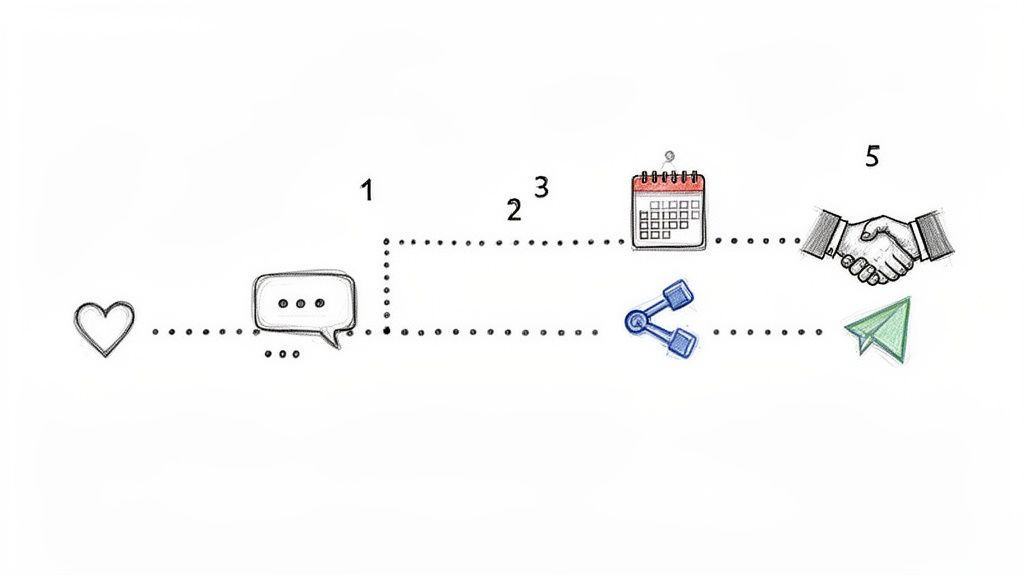
The system works by establishing a presence in the prospect's notifications over several days. When your name finally appears in their connection requests, it's not the first time they have seen it. A lead generation agency tested this method and saw their connection acceptance rate jump from a typical 32% on cold requests to 71% after a warm-up sequence. This resulted in 780 additional qualified connections from the same outreach volume.
Why This Method is Effective
- Increased Acceptance Rates: Familiarity breeds trust. Prospects are far more likely to accept requests from someone who has shown genuine interest in their work.
- Algorithmic Favor: Interacting with a user's content signals to LinkedIn that your profiles are relevant to each other, potentially boosting your visibility in their feed.
- Reduced Ignores: Cold requests are often ignored, which can negatively impact an account's trust score. Pre-engagement significantly lowers the chance of your request being marked as "I don't know this person."
Actionable Implementation Steps
- Identify Active Prospects: Filter your lead lists to prioritize individuals who have posted on LinkedIn within the last 7-14 days. This ensures your engagement efforts are not wasted.
- Define Your Engagement Sequence: Create a multi-day plan. For example, Day 1: Like a recent post. Day 3: Leave a thoughtful, value-add comment on a different post. Day 5: Send the connection request with a personalized note referencing your previous interaction.
- Craft Authentic Comments: Avoid generic comments like "Great post!" Instead, reference a specific point from their content and add your own insight or ask a follow-up question.
- Automate Sequentially: Use tools that support multi-step campaigns to schedule these micro-engagements. This ensures a natural-looking delay between actions without manual tracking.
- Monitor Your Metrics: Track your connection acceptance rate and unconnect rate. If more than 15% of new connections are removing you, your follow-up messaging may be too aggressive or your initial engagement felt inauthentic.
4. LinkedIn Lead Magnet + Link-in-Bio Strategy
This LinkedIn growth hacking method shifts the focus from direct outreach to value-driven lead capture. Instead of asking for a meeting, you offer a high-value content asset, a "lead magnet," such as a playbook, salary guide, or ROI calculator. The goal is to drive profile visitors to an external landing page via a link in your profile's custom button or featured section, where they exchange their contact information for the resource.
This strategy builds an owned marketing list, giving you a direct line of communication for email nurture sequences and retargeting campaigns outside the LinkedIn ecosystem. A recruitment agency offering a niche "Salary Guide," for instance, could see 400 downloads in two weeks. Those new contacts can then be entered into a welcome email sequence with a high open rate, warming them up for future conversations.
Why This Method is Effective
- Builds an Owned Asset: Captures email and company data, creating a marketing list that you control, independent of LinkedIn's algorithm or restrictions.
- High-Intent Leads: Individuals who download a resource specific to their pain points are demonstrating a clear interest, making them more qualified than a cold connection.
- Enables Multi-Channel Nurturing: Once you have their email, you can engage leads through automated follow-ups, newsletters, and targeted ad campaigns on other platforms.
Actionable Implementation Steps
- Create a High-Value Lead Magnet: Develop a resource directly tied to your ideal customer's primary challenges. A SaaS company might create a "B2B Sales Playbook" PDF.
- Set Up a Landing Page: Build a simple, high-converting landing page with a clear call-to-action (CTA) and a form to capture names, emails, and company information.
- Promote the Link on LinkedIn: Add your landing page URL to your profile's custom button ("View my playbook") and create a post for your featured section that sells the value of the download.
- Embed Tracking Pixels: Add tracking pixels (e.g., Meta Pixel, Google Analytics) to your landing page to build retargeting audiences and measure traffic sources.
- Configure an Email Automation Sequence: Set up an automated workflow in your email marketing tool to immediately deliver the resource and follow up at timed intervals (e.g., 24 hours, 3 days, 7 days) with additional value. If conversion rates are below 8%, re-evaluate the offer, copy, or landing page design.
5. Strategic Comment Jacking on Viral Posts
This LinkedIn growth hacking technique centers on placing well-crafted, value-adding comments on high-engagement posts from industry leaders, influencers, or competitors. Instead of creating content from scratch, you "jack" the visibility of a viral post to divert attention to your own profile. By commenting early and thoughtfully, you position your insight in front of a large, relevant audience, which drives profile views, connection requests, and inbound leads.
The strategy works because LinkedIn's algorithm promotes posts with high early engagement, and comments are a key part of that metric. A valuable comment that receives its own likes and replies can rise to the top of the comment section, effectively becoming a mini-post within a post. A marketer who adds an original data insight to a trending post could see their comment get 200 likes, resulting in dozens of profile visits and new connection requests from their target audience.
Why This Method is Effective
- High-Leverage Visibility: Gain exposure to thousands of relevant professionals without needing your own large following.
- Authority by Association: Aligning your profile with respected thought leaders builds credibility and positions you as an expert.
- Inbound Lead Generation: A compelling comment can pique curiosity, prompting prospects to view your profile and initiate a conversation.
Actionable Implementation Steps
- Identify Key Influencers: Follow 20-30 top voices, industry publications, and even competitors in your niche. Turn on notifications for their posts.
- Act Within the "Golden Hour": Post your comment within the first 90-120 minutes of the original post going live to maximize its algorithmic push.
- Craft a Value-Driven Comment: Don't just agree. Add a relevant statistic, a contrarian viewpoint backed by logic, or a personal experience that enriches the conversation.
- Answer Unasked Questions: Read through the first few comments to see what questions are emerging. Craft your comment to answer one of them directly, providing immediate value.
- Include a Soft CTA: End your comment with an open-ended question to encourage replies or a statement that invites people to check your profile for more context (e.g., "I covered this exact data point in my recent profile feature").
6. Automated Sequencing with Account Warm-Up Safety Rules
This LinkedIn growth hacking technique involves using automation to execute multi-step outreach campaigns while strictly adhering to safety protocols. Instead of sending a single connection request and hoping for a response, this method deploys a sequence of actions over several days, such as profile views, connection requests, and multiple follow-up messages. The key is to run these sequences within a framework of safety rules that mimic human behavior to avoid detection.
The system works by programming an automation tool to perform a series of touchpoints for each prospect. For example, a 7-step sequence over 14 days might produce a 35% response rate, compared to just 12% from a single request. By building in randomized delays, daily action limits, and conditional logic, you can maintain consistent, personalized follow-up at a scale that is impossible to manage manually. This is where BIDVA accounts become crucial; their high trust score allows them to sustain higher, yet safe, activity levels.
Why This Method is Effective
- Persistent Follow-Up: Increases response rates by staying top-of-mind with prospects who miss the initial connection request.
- Improved Efficiency: Automates the entire outreach process, from initial contact to multiple follow-ups, freeing up your team to focus on qualified leads.
- Safe Scaling: When combined with account warm-up rules, it allows for high-volume outreach without triggering LinkedIn's security algorithms.
Actionable Implementation Steps
- Choose a Safe Automation Tool: Select a platform known for its built-in safety features, such as randomized delays, daily limits, and human-like activity emulation.
- Design Your Sequence: Map out a logical flow of actions. A common sequence is: Profile View > Wait 1 Day > Connection Request with Note > Wait 3 Days > Follow-Up Message 1 > Wait 5 Days > Follow-Up Message 2.
- Set Conservative Daily Limits: Start with low volumes (e.g., 20-25 connection requests, 40 messages per day) and gradually increase as the account's activity history builds.
- Incorporate Personalization: Use custom fields like
{firstName}and{companyName}in your messages. Manually personalize the first few sentences for high-value prospects. - Monitor Performance: Track key metrics like connection acceptance rate, reply rate, and block/unconnect rates. If you see negative signals, reduce the aggressiveness of your sequence. Following a proven safe LinkedIn automation workflow is essential to reduce ban risk.
7. Niche-Specific Profile Optimization for Algorithmic Discoverability
This LinkedIn growth hacking technique shifts the focus from outbound outreach to inbound attraction by treating your profile as a high-intent landing page. The goal is to optimize every element of your profile (headline, summary, experience, featured section) with hyper-specific keywords that your ideal prospects are actively searching for. This turns your profile into a magnet, drawing in qualified leads through LinkedIn's own search algorithm.
Instead of a generic title like "Sales Director," a profile might use "GTM Strategy for Seed-Stage FinTech Founders." This specificity attracts fewer, but far more relevant, profile viewers. A fractional CFO, for example, optimized their profile for terms like "e-commerce inventory financing" and booked over $150K in retainers from inbound leads who found them via search. The core idea is to win on relevance, not volume.
Why This Method is Effective
- Attracts High-Intent Leads: Prospects who find you through search are already looking for a solution, making the sales conversation much warmer.
- Builds Authority & Credibility: A profile finely tuned to a specific niche positions you as an expert, not a generalist, which builds immediate trust.
- Automated Lead Flow: Once optimized, your profile works 24/7 to attract prospects, creating a passive and sustainable lead generation channel.
Actionable Implementation Steps
- Identify Niche Keywords: Use LinkedIn's search bar and observe the auto-suggestions for your industry. Note the specific long-tail phrases people use to find experts.
- Infuse Keywords Strategically: Weave 5-7 core keywords throughout your headline, "About" section, experience descriptions, and skills. Your headline should clearly state who you help and the outcome you provide.
- Optimize the Featured Section: Pin case studies, testimonials, or articles that directly address the pain points of your target niche. This provides immediate social proof.
- Request Keyword-Rich Recommendations: When asking for recommendations, prompt your clients to mention the specific problems you solved or results you delivered using your target keywords.
- Track Profile Analytics: Monitor your "Search appearances" in your LinkedIn dashboard to see which keywords are driving traffic. You can also track the titles of people viewing your profile to confirm you are attracting the right audience. For a deeper dive, you can learn how to customize LinkedIn profiles for maximum lead generation.
8. LinkedIn Article Publishing for Authority Building and Algorithm Amplification
This LinkedIn growth hacking strategy moves beyond short-form posts to establish deep authority through long-form articles. By consistently publishing detailed, value-driven content (1,500+ words), you tap into a different part of LinkedIn's algorithm that rewards substance and depth. These articles act as evergreen assets, attracting long-tail traffic from both LinkedIn's internal search and external search engines for months or even years.
The system is effective because articles position you as a thought leader, not just a participant in conversations. A consultant who publishes a deep-dive analysis on "Automations That Don't Trigger Bans" can attract 12,000 views and 40 qualified inbound leads by directly addressing a high-stakes problem for their target audience. This content builds trust before the first conversation even happens.
Why This Method is Effective
- Algorithmic Longevity: Unlike posts that have a 24-48 hour lifespan, articles are indexed and can surface in searches long after publication, creating a sustained lead flow.
- Authority & Trust: In-depth content demonstrates genuine expertise, which is a critical differentiator. It separates you from those who only share surface-level insights.
- Lead Quality: The leads generated from articles are often highly qualified, as readers have already consumed your detailed perspective and are pre-sold on your expertise.
Actionable Implementation Steps
- Identify High-Pain Problems: Brainstorm topics that solve a specific, urgent problem for your ideal customer. Think about the questions they ask on sales calls.
- Develop a Unique Framework: Don't just regurgitate common advice. Present your own data, case studies, or a contrarian take to make your content memorable and shareable.
- Optimize for Discovery: Craft a curiosity-driven headline with relevant keywords. Structure the article with clear headings, lists, and bold text for readability.
- Establish a Publishing Cadence: Aim for consistency, such as two to four articles per month, to build momentum and train the algorithm to favor your content.
- Promote Your Article: After publishing, create several short-form posts that link back to the article, each highlighting a different key takeaway. This primes the algorithm and drives initial traffic. A crucial aspect of algorithmic discoverability involves cultivating a strong personal brand; explore strategies for effective personal branding for consultants to refine your professional image.
9. Conversation-Starter Content + Inbound DM Strategy
This LinkedIn growth hacking technique shifts the focus from purely outbound messaging to generating inbound leads through strategic content. The method involves publishing native LinkedIn posts designed to provoke discussion, then systematically engaging with commenters to move promising interactions into private DMs. It effectively turns your public content feed into a self-replenishing funnel for qualified conversations.
Instead of just broadcasting information, the goal is to create posts that act as conversation magnets. For example, a founder sharing candid lessons from a failed experiment might attract comments from empathetic peers, creating perfect openings for partnership discussions. Similarly, a recruiter posting actionable hiring tips can easily transition engaged commenters into inquiries about their services. This transforms passive profile viewers into active, inbound prospects.
Why This Method is Effective
- High-Intent Leads: Commenters are pre-qualified by their interest in your topic. They are often more receptive to a direct message because they initiated the engagement.
- Builds Authority & Trust: Consistently sharing valuable or thought-provoking content establishes you as an expert, making prospects more likely to trust your outreach.
- Algorithm Amplification: High-engagement posts (especially with numerous comments) are favored by the LinkedIn algorithm, increasing your content's reach and attracting more potential leads.
Actionable Implementation Steps
- Identify "Controversy Lite" Topics: Choose subjects in your industry that have differing opinions but are not overly divisive. The goal is to spark debate, not alienate your audience.
- Post with a Direct Question: End your posts with a clear call-to-action that encourages comments, such as "What's the one metric you'd add to this list?" or "Have you seen this work in your industry? Let me know below."
- Engage Immediately: Respond to every comment, especially within the first hour of posting. This fuels the algorithm and shows commenters you are actively listening.
- Transition to DMs Authentically: After a brief public exchange, send a personalized DM. Reference their specific comment directly, for example: "Appreciate your point about X in my post. It made me think... mind if I ask you a quick question about it?"
- Track and Replicate Success: Monitor which post formats and topics generate the most high-quality engagement. Double down on what works to create a predictable inbound lead flow.
10. Competitive Mapping + Strategic Account Targeting on LinkedIn
This LinkedIn growth hacking technique involves systematically identifying and analyzing your competitors' organizations, employees, and customer bases directly on the platform. By using LinkedIn's search filters and company pages, you can build hyper-targeted outreach lists for account-based marketing (ABM) or strategic poaching campaigns. It's a method for turning a competitor's strength into your opportunity pipeline.
The process works by treating LinkedIn as a live database of competitive intelligence. For instance, a sales team can build a list of users at a rival company by searching for job titles that include the competitor's product name (e.g., "HubSpot Specialist"). This allows them to run tailored outreach campaigns highlighting migration benefits, case studies, or superior features, directly engaging users who are already familiar with the problem your product solves.
Why This Method is Effective
- Precision Targeting: Moves beyond broad demographic targeting to engage prospects based on their direct experience with a competing solution.
- High-Relevance Messaging: Your outreach is instantly relevant because it addresses a known pain point or offers a direct upgrade to a tool the prospect already uses.
- Strategic Intelligence: Provides valuable insights into a competitor's team structure, key personnel, and customer footprint, informing both sales and product strategy.
Actionable Implementation Steps
- Map Competitor Accounts: Start by following your top competitors' company pages. Go to their "People" tab to see employee distribution by role, location, and education.
- Use Boolean Search Strings: Create advanced searches to find people who currently or formerly worked at a competitor, or who list a competitor's tool in their profile. Example:
("Head of Sales" OR "Sales Director") AND ("Competitor Inc."). - Identify Their Customers: Look for public posts, testimonials, or case studies where individuals mention using a competitor's product. Add these individuals and their companies to a dedicated outreach list.
- Enrich Profile Data: Before outreach, use external tools to gather firmographic or technographic data to further qualify the target accounts.
- Craft Value-Focused Messaging: Frame your outreach around the value you offer, not just bashing the competition. Focus on solving their problems better, faster, or more cost-effectively. For example, "Saw you're using [Competitor Tool]. Many teams we work with switch to us for [Specific Benefit]."
LinkedIn Growth Hacks - 10-Point Comparison
| Strategy | Implementation Complexity 🔄 | Resource Requirements ⚡ | Expected Outcomes 📊⭐ | Ideal Use Cases 💡 | Key Advantages ⭐ |
|---|---|---|---|---|---|
| Multi-Account Outreach with Warmed Profiles | High — account setup, verification, coordination, ongoing maintenance | High — multiple verified accounts, proxies, team, automation tools | Large volume lifts (3–5x sends), better deliverability, segmented risk. ⭐⭐⭐ | Agencies, large B2B outreach, parallel persona campaigns | Scale outreach safely, risk isolation, faster lead velocity |
| AI-Powered Hyper-Personalized Message Sequences | Medium — AI integration, prompt engineering, QA workflows | Medium–High — AI credits, enrichment data, integrations (GPT/Claude) | Significantly higher response quality and rates; scalable personalization. ⭐⭐⭐⭐ | High-volume personalization (SaaS, recruitment, SDR teams) | Personalized at scale, saves time, learns from replies |
| Connection Request Warm-Up with Micro-Engagement Strategy | Medium — scheduling multi-day engagement patterns and rules | Low–Medium — automation tools, time for contextual comments | Much higher acceptance (60–75%) and lower ignore/archive rates. ⭐⭐⭐ | Targeted prospecting, recruiters, aged accounts | Boosts acceptance, creates familiarity, reduces spam placement |
| LinkedIn Lead Magnet + Link-in-Bio Strategy | Medium — content creation, landing page and tracking setup | Medium — content production, landing pages, email/CRM stack | Builds owned list and long-term qualified leads; lower CPL over time. ⭐⭐⭐ | Inbound lead gen, funnel builders, SaaS marketers | Owned data, retargeting, persistent assets outside LinkedIn |
| Strategic Comment Jacking on Viral Posts | Medium — constant monitoring and rapid high-quality responses | Low — notification tools, time-sensitive attention | Rapid spikes in profile visits and inbound messages; high visibility. ⭐⭐⭐⭐ | Thought leaders, growth hackers, visibility-focused campaigns | High reach with low content effort, fast profile traffic |
| Automated Sequencing with Account Warm-Up Safety Rules | Medium — sequence design, safety tuning, CRM integration | Medium — sequencing platform, monitoring, multi-account support | Higher persistent response rates with reduced ban risk. ⭐⭐⭐ | Multi-touch outreach, agencies, SDR teams needing scale | Consistent follow-up, safety rules reduce platform risk |
| Niche-Specific Profile Optimization for Algorithmic Discoverability | Low–Medium — keyword research, profile and content edits | Low — content time, analytics tracking, occasional refreshes | Increased inbound and higher-quality organic leads over weeks. ⭐⭐⭐ | Consultants, specialists, individuals targeting narrow niches | Passive, compounding visibility; attracts self-qualified prospects |
| LinkedIn Article Publishing for Authority Building | Medium — regular long-form content creation and promotion | Medium–High — writing time or hire, editing, cross-promotion | Strong authority, long-tail traffic and lead generation. ⭐⭐⭐⭐ | Thought leadership, consultants, content-driven brands | High organic reach for standout articles; credibility builder |
| Conversation-Starter Content + Inbound DM Strategy | Medium — daily posting cadence and active community management | Medium — content creation, response time, DM follow-up workflows | High engagement and qualified inbound DMs; compounding audience growth. ⭐⭐⭐ | Creators, founders, agencies converting engagement to demos | Generates warm, qualified leads from active commenters |
| Competitive Mapping + Strategic Account Targeting on LinkedIn | Medium — research, boolean search, list building and enrichment | Medium — Sales Navigator, enrichment (ZoomInfo/Apollo), CRM | Highly targeted outreach with shorter cycles and better relevance. ⭐⭐⭐ | Account-based campaigns, competitor displacement efforts | Precise targeting, tailored messaging, measurable account wins |
Building Your Growth Engine: From Tactics to System
We've explored a powerful arsenal of ten distinct LinkedIn growth hacking strategies, moving far beyond generic advice. From the foundational strength of multi-account outreach using warmed profiles to the nuanced art of comment jacking and authority building through long-form content, each tactic offers a unique lever for generating B2B pipeline. The real breakthrough, however, isn't in mastering just one of these plays. It's about understanding how they interconnect to form a resilient, scalable, and predictable growth engine.
The core principle that separates amateur efforts from professional execution is the shift from isolated campaigns to an integrated system. Imagine stacking these strategies: you start with niche-specific profile optimization to attract the right inbound interest. Then, you deploy multi-account outreach with AI-powered personalized messages, all while running a conversation-starter content strategy that pulls prospects into your DMs. Each element supports and amplifies the others.
Synthesizing Tactics into a Cohesive Strategy
The true power of modern LinkedIn growth hacking lies in combination. A single tactic might yield temporary results, but a system creates sustainable momentum. Your goal is to move beyond one-off efforts and build an "always-on" machine that consistently feeds your pipeline.
Consider this powerful sequence:
- Foundation: Begin with a portfolio of warmed, ID-verified accounts. This is your safety net and the bedrock of your scaling efforts. It provides the capacity to execute everything else without jeopardizing your primary brand or personal profile.
- Attraction: Implement the LinkedIn Lead Magnet + Link-in-Bio and Article Publishing strategies. These build authority and create assets that pull prospects toward you, establishing credibility before you even send a connection request.
- Engagement: Use Strategic Comment Jacking and the Micro-Engagement Warm-Up to get on the radar of key decision-makers. This "warms up" the relationship and makes your subsequent outreach feel familiar, not cold.
- Execution: Finally, launch your AI-Powered Hyper-Personalized Message Sequences through your multi-account setup. Because you've already established credibility and familiarity, your connection and response rates will be significantly higher than a standard cold outreach campaign.
This layered approach transforms your LinkedIn presence from a simple networking tool into a sophisticated lead-generation apparatus. It’s no longer about just sending more connection requests; it's about engineering a complete customer journey on the platform.
From Manual Effort to Automated System
The final piece of this puzzle is intelligent automation. Each strategy we've covered, from warming up accounts to sequencing messages, can be streamlined with the right tools and safety protocols. This is where concepts like automated sequencing with built-in safety rules become critical. By setting clear parameters and mimicking human behavior, you can execute these complex plays at a scale that would be impossible to manage manually.
This systematic approach is the future of B2B growth on LinkedIn. It’s a methodical process of building, measuring, and optimizing a machine that works for you 24/7. Your first step is to choose one or two of these strategies, implement them diligently, and track your metrics. As you master each component, you can begin layering them together, creating a formidable growth engine that drives predictable and scalable results for your business. The path to mastering LinkedIn growth hacking is paved with strategic integration, not isolated tactics.
Ready to build the foundation for a truly scalable outreach system? The safety and capacity of your entire LinkedIn growth hacking operation depend on the quality of your accounts. Secure your operations with high-trust, aged, and ID-verified profiles from BIDVA to run advanced multi-account strategies without the constant risk of restrictions. Visit BIDVA to get the assets you need to scale safely.
.png)



.svg)