LinkedIn Sales Prospecting: The 2026 Playbook

Most LinkedIn advice gets one thing wrong. It treats LinkedIn sales prospecting like a volume contest.
Send more requests. Add more leads. Push more messages through automation. Then people wonder why acceptance rates slide, replies dry up, and accounts get restricted. The issue usually isn't effort. It's that the system is built backwards.
LinkedIn is still the center of gravity for B2B outreach. Over 80% of B2B leads sourced through social media come from LinkedIn, and the platform is 277% more effective than other networks according to these LinkedIn sales benchmarks. The same benchmark set notes that salespeople who actively engage on LinkedIn are 51% more likely to meet quota. That should settle the platform question.
The key question is how to operate there without wasting good profiles, good lists, and good time.
The popular playbook says scale first and clean it up later. In practice, the teams that win do the opposite. They start with trustworthy profiles, tight segmentation, short lead lists, and message sequences that look and feel human. Then they scale the process across multiple accounts only after the workflow is stable.
That matters even more now because agencies, SDR teams, recruiters, and founders aren't running one profile anymore. They're often managing many. A single-user tactic doesn't solve a team-level pipeline problem. You need an operating model.
AI helps, but only when it's pointed at the right problem. It should improve research, targeting, and message relevance. It shouldn't be used to mass-produce generic outreach at higher speed. If you're sorting through where AI fits, this guide on integrating AI tools into your lead generation strategy is useful because it treats AI like workflow infrastructure, not magic.
Introduction Beyond the Numbers Game
The fastest way to break LinkedIn is to chase activity metrics that look productive but don't create conversations.
A rep can send a large batch of connection requests in a day and feel busy. A manager can look at dashboard totals and think the machine is working. Then the campaign stalls. Connection quality drops. Follow-ups feel flat. Prospects stop responding because every message sounds like every other message they've ignored that week.
That's why strong LinkedIn sales prospecting starts with a blunt shift in mindset. More outreach isn't the goal. More qualified conversations are.
Why volume-first prospecting fails
The problem with high-volume tactics isn't just lower quality. It's operational damage.
When teams rely on generic requests and repetitive messaging patterns, LinkedIn starts seeing the behavior before prospects do. Restrictions usually don't arrive because a team used one tool. They happen because the overall pattern looks synthetic. That's a workflow problem, not a software problem.
Your real bottleneck usually isn't lead count. It's trust at the profile level, message level, and sequence level.
Often, teams also ignore the profile source itself. They run outreach from weak accounts with thin networks, little activity history, and no credibility signals. Then they blame copy. Copy matters, but the profile sends the first message before the DM does.
What a scalable playbook actually looks like
A usable system has four parts:
- Credible profiles: Prospects check the person before they answer the message.
- Narrow segments: Small, relevant lists outperform giant exports.
- Sequenced outreach: One message rarely books the meeting.
- Controlled scale: Multi-account operations only work when activity looks natural.
Here, most generic advice falls apart. It gives single-profile productivity tips to people who are trying to run team-level pipeline. Those aren't the same problem.
A founder protecting a main account, an SDR manager running several reps, and an agency handling client campaigns all need a playbook that accounts for profile trust, process design, and account safety. That's the difference between a campaign that lasts a week and a system that keeps producing.
Foundations for Success Your Profile and Network
A LinkedIn profile used for prospecting shouldn't read like a resume. It should function like a sales page with a real person attached to it.
When a prospect receives your request, they don't start by analyzing your offer. They scan your name, photo, headline, company, activity, and mutual context. If those signals don't add up, your message doesn't get the benefit of the doubt.
Build a profile that can carry outreach
Think about the prospect's internal checklist. They want to know three things quickly. Is this person real? Are they relevant to my role? Is this likely to be spam?
Your profile should answer those questions before the inbox opens.
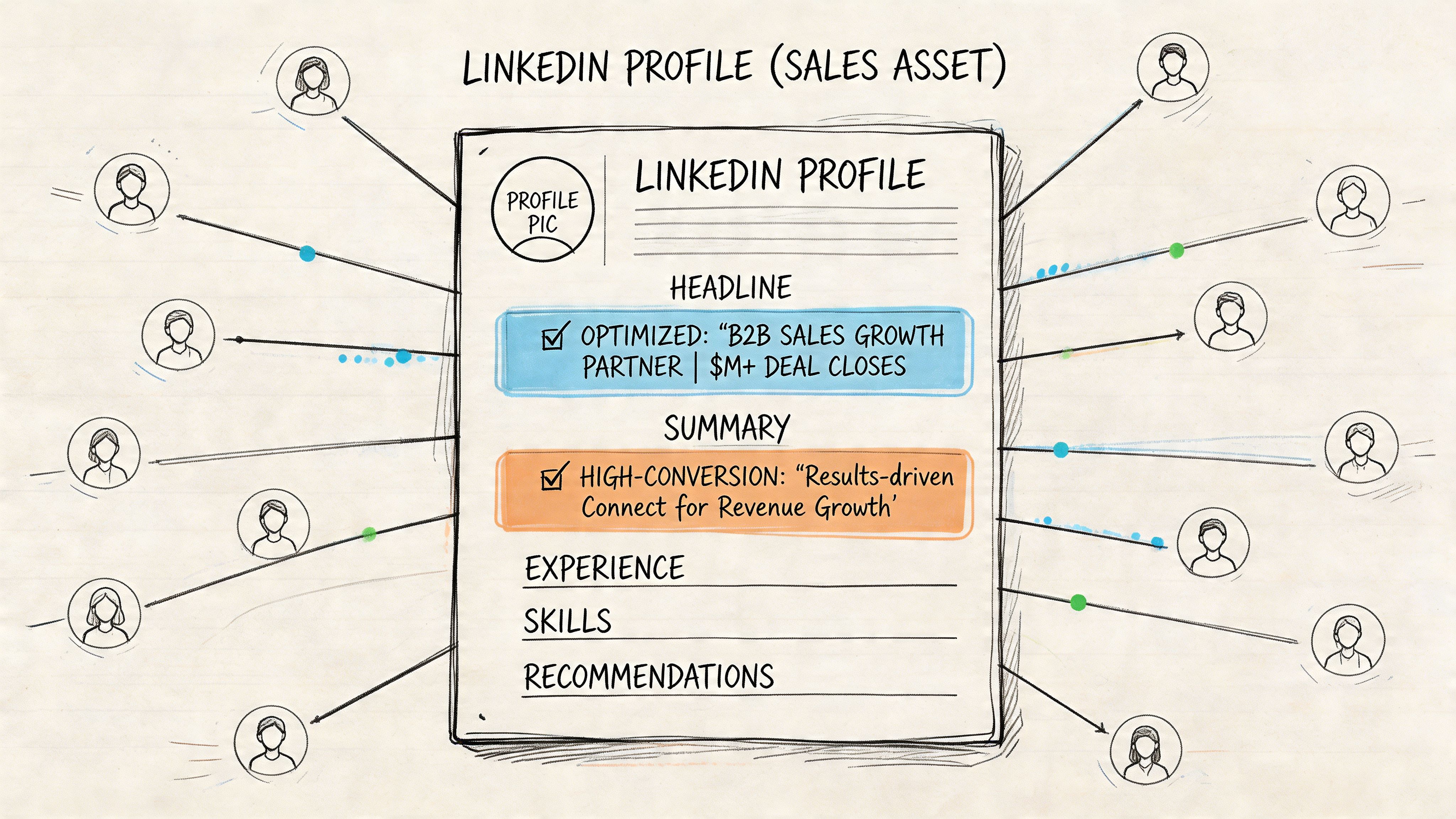
- Headline: Don't waste it on a job title alone. Use it to show the problem you solve and who you help.
- Banner: Use the space to reinforce positioning. A clean value statement, niche focus, or proof point works better than generic branding.
- About section: Write for buyers, not recruiters. Explain the kinds of problems you help with, the teams you work with, and the kinds of conversations worth having.
- Featured section: Add assets a prospect can use to validate you. That might be a case study, benchmark post, lead magnet, or event clip.
- Recent activity: Keep enough visible activity on the profile that it doesn't look dormant.
A weak profile can ruin a strong campaign. A credible profile can rescue an average one.
For teams that need a cleaner setup standard, this breakdown on building trustworthy LinkedIn profiles with lower ban risk is worth reviewing because it focuses on the account signals that affect trust, not cosmetic tweaks.
Don't build a random network
A lot of reps accept nearly every request because they think bigger networks create more authority. They do create bigger numbers. They don't always create more trust.
Your network should make your profile look like it belongs in your market. If you sell to B2B SaaS leaders, your connections should reflect operators, founders, revenue leaders, marketers, and adjacent partners in that space. If you're recruiting in a vertical, your network should look native to that hiring market.
That matters for two reasons:
- Mutual connections can raise comfort before the first reply.
- The overall shape of your network affects how relevant your account looks to new targets.
What good network building looks like
Network building should be intentional, not passive.
- Prioritize relevance over count: Connect with people in your ICP, customers, channel partners, and industry operators.
- Use content as a filter: People who react to your posts or comment in your niche are warmer than cold list entries.
- Avoid obvious mismatch: A profile selling into HR that mostly connects with unrelated audiences looks off.
- Keep account behavior consistent: Profile visits, light engagement, and thoughtful connection building support outreach better than sudden bursts of direct messaging.
Practical rule: Your profile should make a prospect think, "This person works in my world," before they ever consider your offer.
Pre-warmed, verified accounts give teams a head start because they don't begin from an empty shell. But even with a stronger starting point, operators still need discipline. If the profile positioning is vague and the network is random, scale only amplifies the weakness.
Advanced Search and Segmentation
Bad targeting creates fake outreach problems.
Teams often rewrite copy, switch tools, and blame automation when the underlying issue is simpler. They're sending decent messages to the wrong cluster of people. No sequence can save that.
The job here isn't to find more prospects. It's to find the next small batch of prospects who should receive the same core message.
Build segments that can support one message
A strong segment has internal coherence. The people in it share enough context that one angle feels naturally relevant.
That usually means filtering by a mix of role, company shape, and trigger. Sales Navigator is useful here because it lets you narrow by the conditions that matter to outreach teams: seniority, function, headcount, geography, industry, and changes in role or company.
If you need a clearer strategic framing before you build lead lists, this primer on B2B customer segmentation is a good companion because it pushes you to define groups by buying reality, not surface attributes.
The shortlist approach works better than giant exports
A common mistake is exporting a huge list and trying to personalize after the fact. That usually produces superficial personalization because the list is too broad.
A better method is to work from curated shortlists. Build a focused set of prospects around one narrow angle, then write one sequence for that group. This keeps the message sharper and the research lighter.
Useful segment inputs include:
- Role alignment: Similar titles often share language, priorities, and objections.
- Company stage: A startup team and an enterprise team may have the same title but very different buying conditions.
- Recent triggers: Job changes, hiring activity, launches, and visible market moves can make outreach more timely.
- Territory logic: Geography affects tone, timing, and market context.
What to filter before you write copy
Before drafting the first message, pressure-test the segment with a few questions.
| Check | What to look for | Why it matters |
|---|---|---|
| Message fit | Can one opening angle apply to most of the list? | If not, the segment is still too broad |
| Profile relevance | Do your accounts look credible to this audience? | Mismatch lowers acceptance before copy matters |
| Trigger strength | Is there an observable reason to reach out now? | Timing improves relevance |
| Decision role | Are these people close to the problem you solve? | Replies from non-owners waste cycles |
Tools matter, but list design matters more. That's also where a connected workflow helps. When LinkedIn activity, account notes, and follow-up tasks live in the same system, reps stop losing context between touches. If your team is cleaning up that handoff, these notes on social CRM platforms for outreach operations are practical.
Smaller segments create a strange advantage. They reduce the amount of personalization you need because the list itself already carries context.
The teams that book consistently don't chase a giant total addressable market inside Sales Navigator. They keep producing the next high-fit slice.
Crafting High-Reply Outreach Sequences
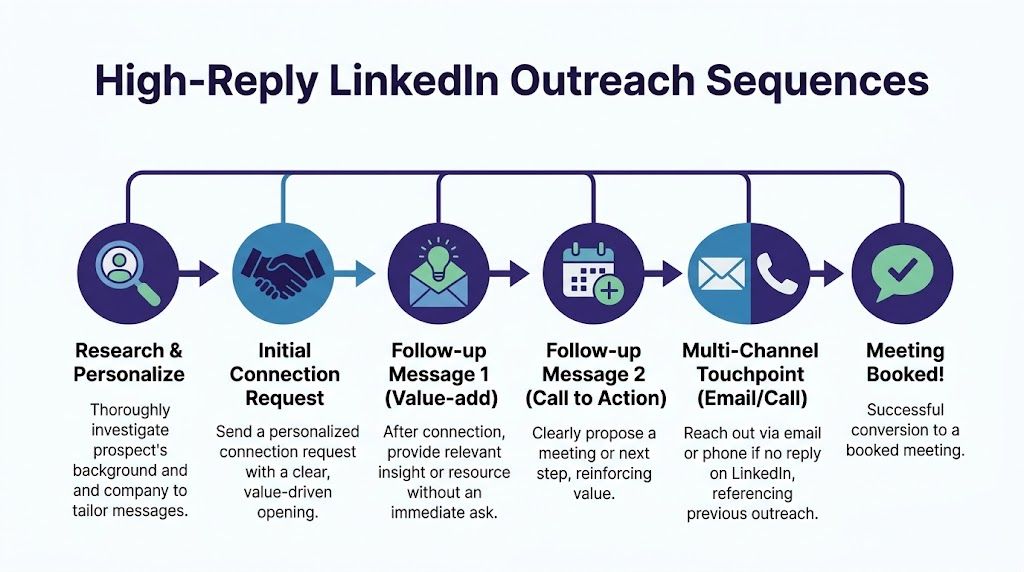
One LinkedIn message rarely wins on its own. The meeting usually comes from the sequence.
That doesn't mean hammering a prospect with repeated asks. It means using a few touches that build familiarity, prove relevance, and make the next step feel low-friction.
The quality of the opening still matters. Personalized connection requests reached 9.36% reply rates versus 5.44% for requests without messages, and reply rates peaked on Tuesday at 6.90% and Monday at 6.85% in Belkins' LinkedIn outreach study. That data aligns with what operators see in live campaigns. Better context and better timing create better starts.
The connection request should do less
Most reps put too much into the first request. They pitch too early, explain too much, and try to force urgency before trust exists.
A better connection request is short, specific, and easy to accept. It should signal relevance, not compress the whole sales call into one sentence.
Examples of angles that usually work better than mini-pitches:
- Shared context: a market, customer type, or operating problem you both recognize
- Relevant trigger: a recent post, role change, launch, or hiring pattern
- Tight curiosity: a concise reason for connecting that doesn't demand a reply
What usually fails is the obvious template language. "I'd love to add you to my network" isn't harmful because it's polite. It's harmful because it says nothing.
A simple cadence that feels human
After the connection is accepted, the follow-up should move in steps. Not every touch needs an ask.
Here's a practical example of a seven-day cadence.
| Day | Action | Objective |
|---|---|---|
| 1 | Send a short thank-you message | Confirm context and avoid pitching immediately |
| 2 | Engage with a relevant post if available | Build familiarity outside the inbox |
| 3 | Send a value-add message | Share a useful observation or resource tied to their role |
| 4 | Pause | Let the interaction breathe |
| 5 | Send a soft CTA | Ask a simple question or offer a brief conversation |
| 6 | Use email or another approved channel if appropriate | Add a second touchpoint without repeating the same message |
| 7 | Send a final light nudge on LinkedIn | Close the loop without pressure |
This works because the sequence respects attention. Each message has a job. None of them tries to do everything.
A measured multi-touch process matters in platform messaging. The operational benchmark cited by Sopro notes that a Connection Request campaign methodology produced a 29.61% acceptance rate and Messenger follow-ups reached 16.86% reply rates, detailed in this LinkedIn lead generation statistics review. The lesson isn't that every team will hit the same numbers. It's that one-touch outreach leaves money on the table.
Here's a useful explainer on sequence structure and message flow:
Write for conversation, not persuasion
Good LinkedIn messages sound lighter than good cold emails. They don't need to carry the full burden of proof. Their job is to open a live conversation.
That changes how you write.
- Skip the company monologue: Prospects don't need your origin story in a first follow-up.
- Name a problem they likely recognize: Keep it concrete enough that it sounds observed, not guessed.
- Offer a reason to respond: A question, comparison point, or practical observation works better than "Interested?"
- Keep the CTA small: Ask for a reaction, not a commitment.
For example, a weak message says:
"Thanks for connecting. We help companies transform their outbound motion with cutting-edge solutions. Would you be open to a call?"
A stronger one sounds closer to this:
"Thanks for connecting. Noticed your team is hiring into outbound. That's usually when message consistency and account coverage start to get messy. Curious if you're solving that in-house or through a distributed SDR setup."
The second message gives the prospect something to react to. It doesn't force a yes-or-no meeting answer.
Most replies come when the prospect feels understood, not when they feel convinced.
Personalization that actually scales
Real personalization isn't adding a token variable to a template. It's choosing a reason for outreach that fits the segment, then adding a detail that proves a human noticed something.
That detail can come from:
- recent posting behavior
- a clear company move
- hiring patterns
- market focus
- product positioning
- a mismatch between team growth and process maturity
The key is restraint. If you scrape five details and jam them into one message, it feels artificial. One clean signal is enough.
Teams also overcomplicate the channel mix. LinkedIn-to-email can work well when the messages are coordinated and the prospect's context stays consistent. What breaks trust is when the email ignores the LinkedIn touch and reads like a different campaign from a different person.
Scaling Safely with Automation and Multiple Accounts
Here, casual advice commonly loses its effectiveness.
It's easy to tell one rep to personalize more. It's harder to help a sales team or agency run outreach across multiple profiles without triggering restrictions, corrupting data, or burning through accounts. But that's the core operating problem once outreach becomes a pipeline function instead of a side task.

A major gap in mainstream prospecting advice is exactly this. According to SalesGenie's discussion of LinkedIn prospecting for B2B sales, 15% of sales accounts were restricted for "inauthentic behavior," while teams using ID-verified accounts with 200 to 500 connections can achieve 2 to 5 times higher daily limits safely. That's the difference between a hobby workflow and an operational system.
Why multiple accounts exist in the first place
Some people still treat multi-account prospecting as a shady workaround. In practice, it often reflects normal team reality.
Agencies manage campaigns for multiple clients. SDR leaders need distributed coverage across territories or offers. Recruiters separate hiring motions by role type or market. Founders protect a primary personal brand while testing outbound from secondary operator profiles.
The problem isn't the number of accounts. The problem is when teams run many accounts with no infrastructure standards.
What safe scaling actually requires
Scaling safely isn't about buying software and hoping the settings are conservative. It's about making the full environment look consistent and believable.
Core requirements usually include:
- Verified, credible profiles: Thin or obviously fresh profiles create friction from the first action.
- Dedicated operating environments: Each account should have stable browser isolation and a clean usage pattern.
- Proxy discipline: Location consistency matters. Sudden changes in behavior context don't.
- Warm-up behavior: Accounts need normal activity, not an immediate flood of connection requests.
- Tool restraint: Expandi, Dripify, PhantomBuster, Waalaxy, and LinkedHelper can support workflows, but none can make reckless behavior safe.
A lot of bans blamed on automation are really caused by impatience. Teams push action volume before the account has history, before the sequence is tested, and before the targeting is tight. That's why one operator can use automation for months without issue while another gets flagged quickly using similar software.
How to distribute work across accounts
The best multi-account systems don't clone the same campaign across every profile. They assign roles.
One account may target founders in one market. Another may cover revenue leaders in a different segment. Another may support recruiter outreach or customer-partner prospecting. Segmentation at the account level reduces overlap and keeps messaging context cleaner.
It also helps to vary the behavioral mix. Strong accounts don't only send requests. They view profiles, accept relevant connections, engage selectively, and maintain enough natural movement to avoid looking like single-purpose bots.
If every account performs the same actions, at the same pace, on the same kind of prospects, the issue isn't the tool. The issue is the footprint.
Set limits around quality, not fear
Teams often ask for one universal safe limit. That's the wrong framing.
The usable limit depends on account age, verification status, connection base, activity history, market, and how synchronized the behavior looks across profiles. A stronger account can usually carry more load than a weak one. A warmed profile can handle patterns that would sink a fresh account.
That said, caution still matters. Aggressive scaling before trust signals are in place is how teams create downtime. A slower ramp with better targeting usually produces more stable throughput over time.
A professional setup looks boring from the outside. Clean account ownership. Separate environments. Realistic pacing. Sequenced activity. Measured list allocation. Tight feedback loops between campaign performance and account health.
That's why high-output LinkedIn sales prospecting isn't really about sending more. It's about building a machine that can keep sending tomorrow.
Measuring What Matters and Optimizing Your Playbook
Many teams track too much and learn too little.
They watch profile views, total sends, and surface activity because those numbers are easy to pull. The useful metrics are narrower. They tell you where trust breaks in the funnel.
The benchmark to keep in mind is process-based. As noted earlier in the operational data from Sopro, a structured Connection Request campaign produced a 29.61% acceptance rate, and Messenger follow-ups reached 16.86% reply rates, outlined in this CRM and prospecting context. That doesn't mean you copy a benchmark and call it strategy. It means you need to know exactly where your own process is outperforming or leaking.
The four metrics that matter
Track these consistently across accounts, segments, and sequences:
- Acceptance rate: Are the right people saying yes to the request?
- Reply rate: Are accepted prospects responding at all?
- Positive reply rate: Are replies moving toward a real sales conversation?
- Meetings booked: Is the campaign producing calendar outcomes, not just chat?
This level of detail often proves sufficient. Once these are clean, you can layer in channel-level and rep-level detail.
What to test when results flatten
If acceptance is weak, don't rewrite the whole sequence first. Check profile credibility and targeting fit.
If acceptance is healthy but replies are poor, the issue usually sits in your first follow-up. Maybe the value proposition is too broad. Maybe the message asks too soon. Maybe the segment wasn't tight enough to support one angle.
A practical testing cycle looks like this:
| Funnel point | Test variable | Common issue |
|---|---|---|
| Connection request | Opening line or personalization angle | Sounds generic or over-pitched |
| First follow-up | Problem framing | Too seller-centric |
| CTA message | Ask size | Too much commitment too early |
| Segment level | ICP filter | List too broad for one message |
Use review loops, not one-off fixes
Good operators review by batch. They don't react emotionally to five ignored messages.
Run a small segment, look at results, inspect examples, adjust one variable, then run the next batch. That rhythm matters even more in multi-account environments because one broken sequence can spread across many profiles fast.
A prospecting playbook becomes reliable when your team can explain why a number moved, not just notice that it moved.
The best teams eventually stop debating whether LinkedIn works. They know where it works, for whom, from which profile types, with which message patterns, and under what operating conditions.
If your team needs durable LinkedIn infrastructure before you scale, BIDVA provides real ID-verified, warmed-up LinkedIn accounts built for outreach operations. That gives SDR teams, agencies, recruiters, and founders a safer starting point for multi-account campaigns, with full ownership and practical setup guidance instead of rented access.