How to Increase Social Selling Index: 2026 Guide

You’re probably active on LinkedIn already. You post now and then, send connection requests, react to prospect content, and maybe run outreach from more than one account. But the results feel uneven. One profile gets profile views and replies. Another gets ignored. A third starts throwing warning signs because activity climbed too fast.
That’s usually when people look up how to increase social selling index. Not because they suddenly care about a score, but because the score exposes something useful. It shows whether your profile is earning trust, whether LinkedIn sees your activity as valuable, and whether your outreach behavior looks like relationship-building or spam.
In practice, SSI becomes even more important when you manage several accounts. A single profile can hide bad habits for a while. A portfolio of profiles won’t. Weak positioning, lazy connection requests, thin content, and unsafe automation patterns start showing up fast in acceptance rates, engagement quality, and account stability. If you’re running outreach for a team or clients, SSI is one of the few built-in signals that tells you whether the engine is healthy.
Why Your Social Selling Index Is More Than Just a Number
Most low-SSI profiles don’t look broken at first glance. They have a headshot, a job title, a few recent activities, and a network that seems decent enough. But then, clear problems emerge. Connection requests get accepted inconsistently. DMs feel cold. Posts don’t travel. Replies come only after repeated follow-up, if they come at all.
That’s not just a content problem. It’s usually a trust problem.
Social selling works best when the buyer sees credibility before they see a pitch. The core philosophy is simple. Build trust and establish credibility before discussing products or services. Consistent engagement with your network’s content also triggers LinkedIn’s algorithmic amplification, which expands post reach and contributes directly to SSI, as noted by DMEXCO’s explanation of how LinkedIn SSI works.
What the score is really telling you
SSI is useful because it compresses several behaviors into one signal. If the score is weak, LinkedIn is usually telling you one of four things:
- Your profile lacks authority. The account doesn’t look like someone buyers want to learn from.
- Your targeting is sloppy. You’re connecting too broadly instead of identifying relevant people.
- Your engagement is passive. Likes and surface-level reactions are replacing actual contribution.
- Your relationships are thin. You’re adding contacts, not building trust.
A lot of outreach teams misread this. They assume more volume will solve weak response rates. It rarely does. More volume on top of a low-trust profile just creates more low-quality impressions.
A poor SSI rarely means you need more activity. It usually means you need better-aligned activity.
Why multi-account teams should care more than everyone else
When you run one profile casually, you can get away with inconsistency. When you run several warmed-up accounts for outbound, every weakness multiplies. If one account posts useful content and another only sends requests, LinkedIn treats them differently. If one account comments with substance and another drops generic one-liners, the gap widens.
That’s why I treat SSI as an operating metric, not a vanity metric. It doesn’t replace pipeline metrics. It sits upstream from them.
For teams and agencies, a rising SSI often means the accounts are doing the right kind of work. They look credible, they engage in-context, and they connect with the right people. A flat SSI often means someone on the team is cutting corners. Usually in profile quality, content quality, or outreach sequencing.
Deconstructing the Four Pillars of Your SSI Score
SSI moves on four equal inputs: Establishing Your Professional Brand, Finding the Right People, Engaging with Insights, and Building Relationships. LinkedIn scores each pillar out of 25, so a profile can look active while still lagging because one area is weak.
That matters even more in multi-account outbound. I can keep two accounts on the same offer, with similar connection volume, and still see different SSI movement because one account has sharper targeting, better comments, or stronger reply quality. SSI is a behavior score. For agencies and sales teams running warmed-up accounts at scale, it helps show whether each profile is operating like a credible peer or just acting like a sender.
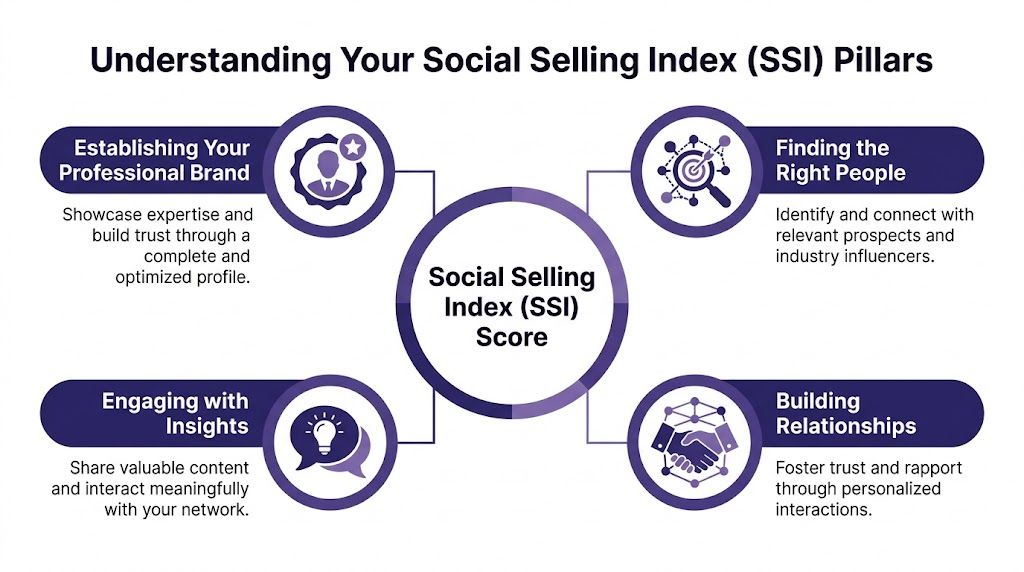
Establishing your professional brand
This pillar measures whether the account looks trustworthy and specific.
A complete profile helps, but completeness alone does not carry much weight if the positioning is vague. The stronger accounts I manage make three things obvious within a few seconds: who they help, what problems they understand, and what perspective they bring to the market. That is the baseline for optimizing your LinkedIn profile.
For multi-account teams, consistency matters. Each account needs its own voice and proof points, but the positioning should still map cleanly to the segment it targets. If one SDR account is built for SaaS founders and another is aimed at RevOps leaders, the messaging, featured content, and social proof should match those audiences. This LinkedIn profile customization workflow for lead generation teams is the kind of setup work that prevents mixed signals before outreach starts.
Finding the right people
This pillar reflects search behavior and network quality.
LinkedIn rewards accounts that connect with relevant people in a defined market. In practice, that means building lists around a real ICP, then adding the surrounding stakeholders who influence deals. Good account operators do not stop at the economic buyer. They map champions, department heads, consultants, recruiters in the niche, and active creators followed by the target audience.
There is a trade-off here. Broad prospecting can grow network size faster, but it usually weakens feed relevance and lowers acceptance quality. Tight targeting slows volume a bit, yet it improves who sees your content, who accepts requests, and who later recognizes your name in the inbox.
Engaging with insights
This pillar tracks contribution quality, not just visible activity.
An account can react all day and still look disposable. SSI tends to move when the profile publishes useful posts, leaves comments that add a point or example, and joins conversations tied to its market. I usually give account managers a simple rule: if a comment could be pasted under any post, it does not help much.
Depth matters here. Short posts keep an account present, but stronger SSI gains usually come from a mix of formats. A sharp text post, a contrarian comment under an industry creator, and occasional long-form content create a stronger expertise pattern than generic daily posting. On scaled programs, I would rather run fewer comments with real context than flood the feed with low-signal engagement that looks automated.
Building relationships
This pillar reflects whether the network behaves like real relationships instead of a contact database.
Accepted requests help. Ongoing conversations help more. The best-performing accounts build familiar touchpoints before they ask for a meeting. That can mean thoughtful comment exposure, a relevant follow-up after a prospect posts, or a message thread that stays focused on the buyer's situation instead of forcing a pitch on day one.
This is also where unsafe automation becomes obvious. High request volume can fill the top of the funnel, but weak reply quality, ignored follow-ups, and repetitive messaging usually show up here first. On multi-account setups, I watch this pillar closely because it reveals whether the team is building trust or just pushing sequence volume.
The pillars work as a system
A strong profile raises acceptance rates. Better targeting improves who sees and responds to your content. Better engagement creates warmer entry points for direct outreach. Better relationships make every future touch easier.
Treat SSI the same way you would treat outbound infrastructure. Each pillar supports the others, and one weak area drags the rest down. That is why single-profile advice often falls short for agencies and sales teams. Once you are running several warmed-up accounts, SSI improvement comes from coordinated operations, not isolated profile tweaks.
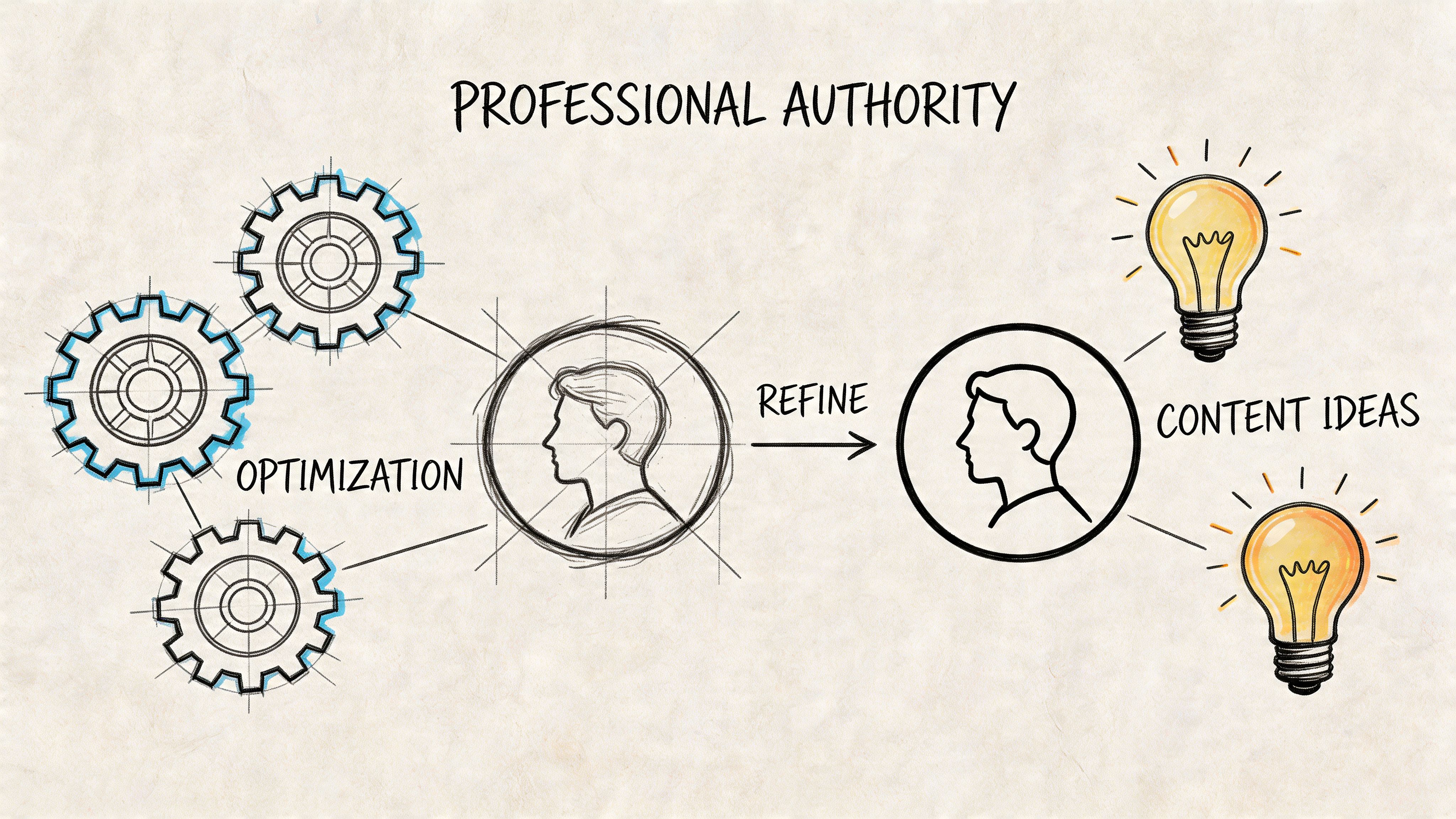
Optimize Your Profile and Content for Authority
The fastest way to waste outreach volume is to send traffic to a weak profile. Prospects click before they reply. If the page doesn’t explain who you help, what you know, and why your content is worth following, they leave.
A focused method of profile optimization plus posting 3 to 5 quality thought leadership pieces weekly can improve SSI by 20 to 30% in 4 to 6 weeks, and profiles optimized this way can see 30% higher engagement rates, according to GetViews’ SSI optimization guide.
Fix the profile before scaling activity
The first job is clarity. Someone should land on the profile and understand your market, your lens, and your credibility within seconds.
I build profiles around buyer context, not employee self-description. That means the headline and About section should reflect the problems you solve, the audience you understand, and the way you think.
A few rules work consistently:
- Headline first. Don’t just state your title. Show the market you serve and the value angle.
- Banner matters. Use it to reinforce positioning, not decorate the page.
- Featured section earns trust. Add articles, case-relevant posts, lead magnets, interviews, or proof of expertise.
- Experience section should support the story. Keep it relevant to your current commercial identity.
- Skills and endorsements should align. Don’t let the profile signal one niche in the headline and another in the skill stack.
If you want a deeper walkthrough on optimizing your LinkedIn profile, that resource does a good job of showing how small profile details change first impressions.
Here’s what a stronger headline looks like in practice:
Helping B2B SaaS teams book qualified meetings through outbound systems, LinkedIn positioning, and account-based messaging
And a weak one:
SDR at Company Name | Sales | Growth | Business Development
The second headline tells me employment. The first tells me expertise.
Write an About section buyers can scan
Most About sections are too broad, too corporate, or too self-focused. Keep it practical.
I work with B2B teams that need outbound to feel credible before the first DM. My focus is LinkedIn positioning, targeted prospecting, and relationship-first outreach that creates conversations instead of resistance.
That style works because it’s specific without sounding inflated.
For teams managing several outreach profiles, I standardize the structure but not the wording. Repeating the exact same headline or About format across multiple accounts creates a footprint and lowers authenticity. Keep the strategic message aligned. Keep the phrasing distinct.
For a practical walkthrough on tailoring profiles for outbound use, this guide on customizing LinkedIn profiles for lead generation is useful, especially if you’re adapting several accounts around different offers or personas.
Build a content system that actually supports SSI
Many individuals fail here because they treat content like a side task. They post when they have spare time, then wonder why nothing compounds.
A better rhythm is simple:
- Pick a narrow set of themes tied to buyer pains, objections, mistakes, and market observations.
- Rotate formats across text posts, short videos, carousels if relevant, and articles for depth.
- Write from live conversations. Good content usually starts in DMs, calls, or objections you keep hearing.
- Stay educational first. Helpful content beats constant product talk.
The platform recommends 3 to 5 quality posts per week. That cadence is enough to show consistency without turning the account into a content treadmill.
Later in the week, use one deeper asset to anchor authority.
What works and what doesn’t
Here’s the blunt version from managing outreach-heavy accounts.
What works
- Original articles because they create stronger authority signals than ordinary status updates.
- Point-of-view posts based on pattern recognition from real work.
- Comments that extend the discussion instead of agreeing politely.
- Content tied to one audience rather than trying to impress everyone.
What doesn’t
- Generic motivation posts with no commercial relevance.
- Product-only updates that read like internal company news.
- AI-polished filler that says little in many words.
- Copy-pasting the same post across every account in a multi-account setup.
Practical rule: if a post could be published by ten different people in ten different industries, it probably won’t help your SSI much.
Authority on LinkedIn is built by specificity. The more your profile and content show clear expertise for a defined audience, the more every later outreach step performs.
Master Strategic Networking and Relationship Building
Once the profile is credible, the next lever is network quality. It is here that most SSI growth either accelerates or stalls. You can’t build strong relationship signals from bad lists and weak requests.
One tactic stands out clearly. Engaging with an ICP’s content before sending a connection request can double acceptance rates. Liking, sharing, and adding thoughtful comments of more than 15 words to 10 to 20 ICP posts daily can raise SSI by 15 to 20 points and help you reach the top 1% in your industry within 30 days, according to Skrapp’s social selling index guide.
Start with account selection, not messaging
A lot of reps obsess over the perfect connection note when the actual problem is the list.
Good prospecting starts by defining who belongs in the network and who doesn’t. I segment targets into a few buckets:
- Primary buyers such as founders, heads of sales, revenue leaders, or recruiters, depending on the offer
- Influencers around the buyer like operators, managers, or specialists who shape opinion internally
- Peer connectors whose audience overlaps with the people I want to reach
- Industry voices whose posts create visible engagement opportunities
SSI improves faster when the account is moving inside a coherent commercial environment. Random additions dilute your feed and make meaningful engagement harder.
If you need practical ideas for growing a relevant network, this article on how to get more connections on LinkedIn is a solid starting point.

Pre-engagement is the real warm intro
Before I send a request from any serious outbound account, I want the target to have a chance to notice the profile organically.
That usually means:
- Viewing the profile
- Reading recent posts
- Leaving one or two thoughtful comments where there’s real context
- Possibly sharing or reacting when it makes sense
The important part is the quality of the comment. Short remarks like “Great post” don’t do much. A comment that adds a perspective, asks a useful question, or connects the idea to a practical situation does far more.
Here’s a simple contrast.
Weak comment:
Great insight. Thanks for sharing.
Better comment:
I’ve seen the same issue in outbound teams. The script usually isn’t the real problem. It’s the mismatch between targeting and profile credibility before the first message.
The second one shows attention and expertise. It also creates familiarity before the invitation arrives.
Write connection requests that feel earned
Most bad requests fail for the same reason. They ask for attention before earning relevance.
Poor request:
Hi, I’d love to connect and tell you about what we do.
Better request:
Saw your post about hiring ramp challenges. We’ve run into the same issue on outbound teams. Thought it made sense to connect.
Short works. Context works. Shared relevance works.
The note doesn’t need to sell. It needs to answer one question in the prospect’s mind. Why is this person reaching out to me?
If the note sounds like the start of a pitch, acceptance drops. If it sounds like the continuation of a visible interaction, acceptance improves.
Relationship building after the accept
A connection accepted is not a relationship built. Many SSI strategies falter when the next move proves too aggressive.
I prefer a three-part follow-up pattern:
| Stage | What to send | Goal |
|---|---|---|
| First touch | Thank them, mention the context, no pitch | Confirm relevance |
| Second touch | Share a useful observation, resource, or reaction to their recent topic | Add value |
| Third touch | Open a light conversation around a pain point or workflow | Create dialogue |
A few habits matter more than clever wording:
- Reply to every meaningful comment and DM. Silence weakens relationship signals.
- Keep the conversation on their world first. Your offer can wait.
- Use their recent activity as context. Nothing feels more human than proving you paid attention.
- Don’t force speed. Fast escalation often lowers trust.
For agency operators and SDR managers, this is also where process discipline matters. Reps should not treat all accounts the same. Some profiles are built for founder-to-founder conversations. Others are better for peer-level discussion. Match the voice to the identity of the account.
Scale Safely with Multi-Account Outreach
Monday morning, five SDR accounts log in within the same hour, send the same style of connection request, and post recycled variations of one content asset. By Friday, acceptance rates dip, reply quality drops, and one account gets restricted for identity checks. I have seen that pattern enough times to treat SSI growth and account safety as one operating problem, not two separate goals.
For teams running several LinkedIn profiles, SSI stops being a personal score and becomes a portfolio metric. A healthy setup spreads activity across warmed accounts with clear roles, stable usage patterns, and enough variation to look like a group of professionals instead of one script copied across seats. That matters even more for agencies and high-volume teams managing account batches through providers such as BIDVA, where operational discipline decides whether scale holds or breaks.
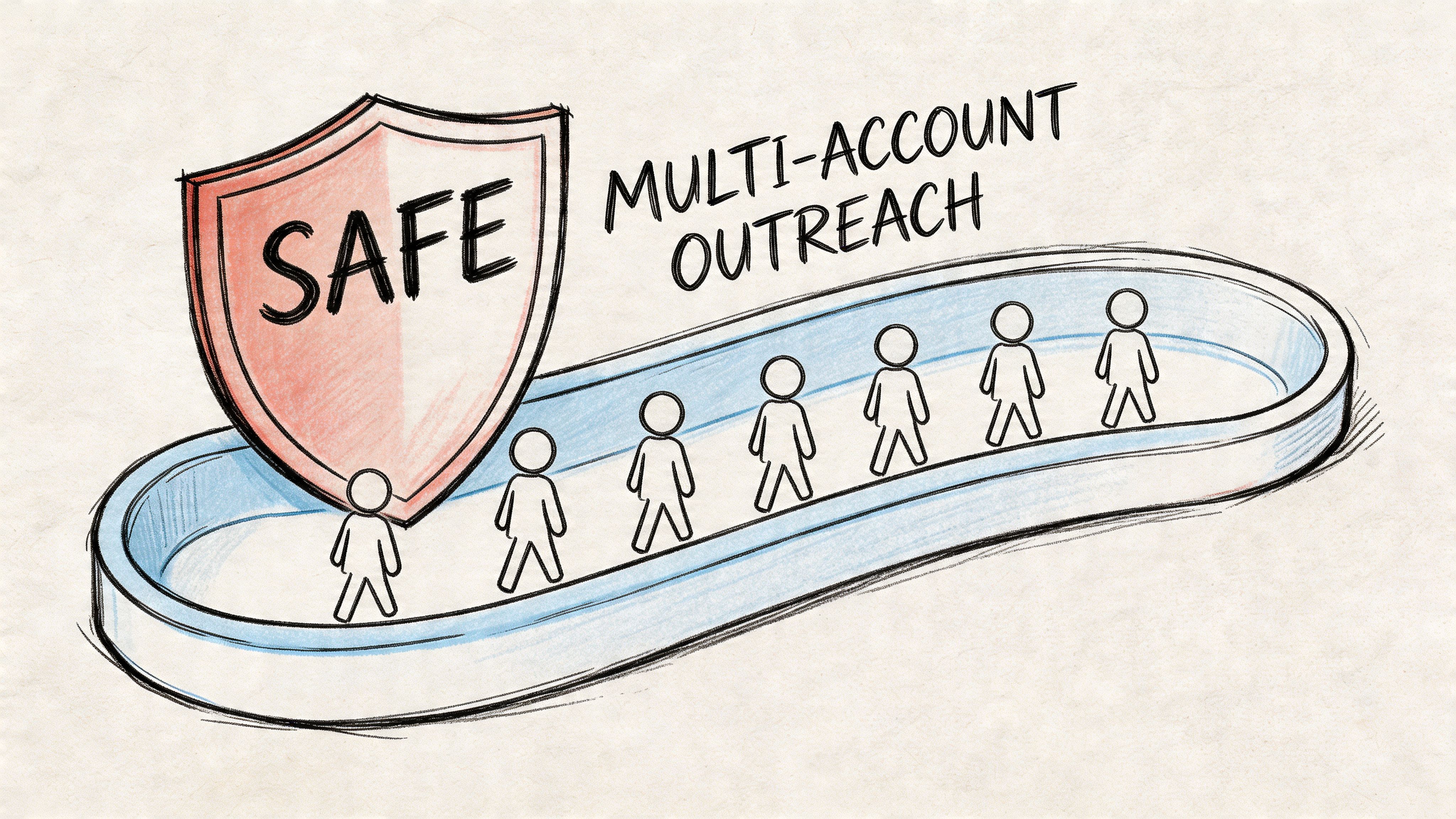
Multi-account SSI requires a different operating model
A single rep can keep one profile natural from memory. A manager handling ten, twenty, or more accounts cannot. The work shifts from personal habit to system design.
That system needs four controls:
- Identity separation across browser profiles, cookies, and session history
- Role-based activity so each account has a believable purpose
- Warm-up pacing for new, dormant, or transferred profiles
- Pattern variation across posting, connection requests, comments, and DMs
I assign lanes early. One profile may publish stronger point-of-view content and handle founder conversations. Another may focus on prospect research, profile views, and selective connection building. A third may carry follow-up and comment-driven nurture. SSI improves faster when each account performs its role well instead of forcing every profile to post, connect, comment, and message at the same volume.
Safety hygiene that matters in practice
The safest multi-account setups are usually the least flashy.
My baseline rules stay simple because simple rules get followed:
- One account, one browser profile
- Consistent login location and device pattern per account
- Gradual increases in activity, especially after account handoff
- Original posts and comments, not synchronized duplicates
- No invite bursts on cold profiles
- Human review before automation scales any sequence
LinkedIn also limits how aggressively an account can send invites, which means each request has to count. In a multi-account setup, wasting invites on weak-fit prospects hurts twice. It lowers acceptance quality and burns capacity that should have gone to better targets.
How I distribute activity across a portfolio
Uniform behavior is easy to spot. I want controlled variation.
Here is the operating split I use most often:
| Account type | Primary focus | Secondary focus | Risk note |
|---|---|---|---|
| Authority account | Articles, strong comments, selective connects | DM follow-up | Keep automation light |
| Prospecting account | Search, profile views, pre-engagement, connection requests | Light posting | Monitor acceptance quality weekly |
| Nurture account | Replies, comments, conversation continuity | Occasional posts | Keep persona and tone consistent |
This setup solves a common scaling problem. Teams often overwork every profile in the same direction because it feels efficient. It is not. Accounts become safer and more effective when the workload matches the profile’s identity, network maturity, and content history.
Automation should support judgment
Automation helps with queues, reminders, pacing, and sequence control. It creates risk when teams let software write the personality of the account.
I keep these rules in place:
- Use multiple message variants
- Pause outreach when a prospect replies or engages publicly
- Audit sent actions every week
- Keep meaningful comments manual
- Use content libraries for prompts, not copy-paste output
Teams building this at scale should also standardize their environment, handoff process, and review cadence. This safe LinkedIn automation workflow that reduces ban risk is a good reference for setting up those controls without turning accounts into predictable bots.
LinkedIn works better when it is part of a wider outbound system
SSI rises faster when LinkedIn activity connects to account research, CRM timing, and email follow-up. That is how high-volume teams keep outreach relevant without overusing one channel.
If LinkedIn is the first touch, email can carry the longer pitch. If email lands first, LinkedIn can provide familiarity through profile views, comments, and selective engagement. Teams comparing the wider stack should review these best tools for email outreach automation alongside their LinkedIn process.
What keeps accounts productive, and what gets them flagged
Works well
- Clear account roles
- Slow warm-up before full outbound load
- Distinct content angles across the portfolio
- Tight prospect filtering
- Weekly review of acceptance rates, replies, and restriction signals
Creates problems
- Identical daily actions across every account
- Mass invites without context or pre-engagement
- Repeated posts, repeated notes, and repeated timing
- Long automation runs without supervision
- Handing reps accounts with no ramp period or safety checklist
The goal is not to make every account busy. The goal is to make every account believable, useful, and stable over time. Teams that treat SSI as a portfolio management problem usually gain more reach with fewer restrictions.
Your Weekly SSI Routine for Consistent Growth
SSI improves when the account follows a repeatable rhythm. Not a burst. Not a “content day” followed by silence. A rhythm.
For a lot of teams, the simplest system works best. Check the SSI dashboard weekly, look at which pillar is lagging, and adjust the next week’s behavior accordingly. If brand is low, improve the profile and publish stronger authority content. If relationship building is low, focus on pre-engagement, replies, and better connection context.
The routine I’d actually run
A good weekly cadence balances public authority and private networking. It also avoids the trap of doing only one kind of work.
Use this as a baseline operating checklist:
| Activity | Daily Frequency | Weekly Goal | Impacted SSI Pillar |
|---|---|---|---|
| Review target accounts and recent prospect activity | Daily | Stay active across relevant ICP segments | Finding the Right People |
| Leave thoughtful comments on relevant posts | Daily | Consistent visible engagement with buyer conversations | Engaging with Insights |
| Respond to DMs and post comments | Daily | Maintain conversation continuity and trust | Building Relationships |
| Send selective connection requests with context | Daily | Build a relevant network without spamming | Building Relationships |
| Publish value-driven posts | Several times per week | Maintain authority and feed visibility | Establishing Your Professional Brand |
| Publish a deeper article | Weekly | Strengthen thought leadership signals | Establishing Your Professional Brand |
| Review SSI pillar movement | Weekly | Identify what needs correction | All pillars |
| Audit account behavior across the portfolio | Weekly | Catch unsafe patterns or weak accounts early | All pillars |
How to read the routine correctly
This isn’t a checklist for fake activity. It’s a checklist for signal quality.
If comments become generic, they stop helping. If connection requests lose context, acceptance quality drops. If posts become repetitive, authority fades. The routine only works when the underlying work is thoughtful.
For multi-account teams, I’d also add one management rule. Never evaluate accounts only by raw output. Review them for credibility. Read the comments. Inspect the profile. Look at what a prospect sees. That’s usually where the full picture emerges.
SSI grows when the account looks useful before it asks for anything.
A high score is valuable because it reflects durable behavior. Better positioning. Better targeting. Better conversations. Better network quality. Once those habits are in place, SSI becomes less of a target and more of a byproduct.
If you’re scaling LinkedIn outreach and don’t want to risk your main profile, BIDVA is built for that use case. They provide real, ID-verified, warmed-up LinkedIn accounts with full ownership, practical transfer guidance, and compatibility with major automation tools, which makes them a strong fit for agencies, SDR teams, recruiters, and founders who need durable accounts for multi-profile campaigns.