What Is LinkedIn Open Profile? A Complete Guide for 2026

You launch a LinkedIn sequence on Monday with solid copy, tight targeting, and a clean account setup. By Wednesday, one profile has hit invitation friction, another is burning through InMail, and the main prospect segment still sits behind the same wall: you cannot message them directly unless they accept your request first.
That is where many outreach programs slow down. Not because the offer is weak, but because the contact path is wrong.
If you have been asking what is LinkedIn open profile, the short answer is simple: it is one of the few LinkedIn features that can remove a major messaging bottleneck. The useful answer is more strategic. Open Profile is not just a profile setting. In practice, it is a routing advantage for sales teams, recruiters, and agencies that need more conversations without stuffing every campaign through connection requests.
The Outreach Wall and How to Get Around It
A familiar pattern plays out in most outbound teams.
An SDR finds the right buyer, personalizes the first line, and clicks send. Then LinkedIn pushes the conversation into the usual funnel: send a connection request, wait, follow up later, hope the prospect accepts. If the account is running at scale, that delay becomes expensive fast.
The problem gets worse when invitation capacity tightens. If you are already working around the LinkedIn connection request limit, every unnecessary request has an opportunity cost. You are spending a network-building action on someone who might have been reachable another way.
Where Open Profile changes the game
Open Profile gives you a direct message path to some people who are not in your network.
That matters because connection requests do two jobs at once. They build your graph, and they act as a gate for messaging. Open Profile separates those jobs. If a prospect has it enabled, you can often start the conversation without first spending a request or an InMail credit.
For teams running multi-account systems in Expandi, Dripify, LinkedHelper, or PhantomBuster, that changes list design. You no longer have to treat every prospect the same way. Closed profiles can stay in slower sequences. Open profiles can move into a faster lane.
A practical prospecting angle
This works best when list building is intentional.
One approach is to combine LinkedIn search behavior with outside sourcing methods. If your team also uses Google-based discovery, this guide on how to scrape LinkedIn contacts from Google Search is useful for finding profile URLs at scale before you sort targets by messaging path.
Tip: Treat Open Profile prospects as a separate audience, not just a filter. They deserve different message logic, different pacing, and different reply handling.
Open Profile is not a loophole. It is a better route. The teams that benefit most are the ones that stop thinking only in terms of “who should we contact” and start thinking in terms of “what is the cheapest and safest path to a real conversation.”
What Exactly Is LinkedIn Open Profile
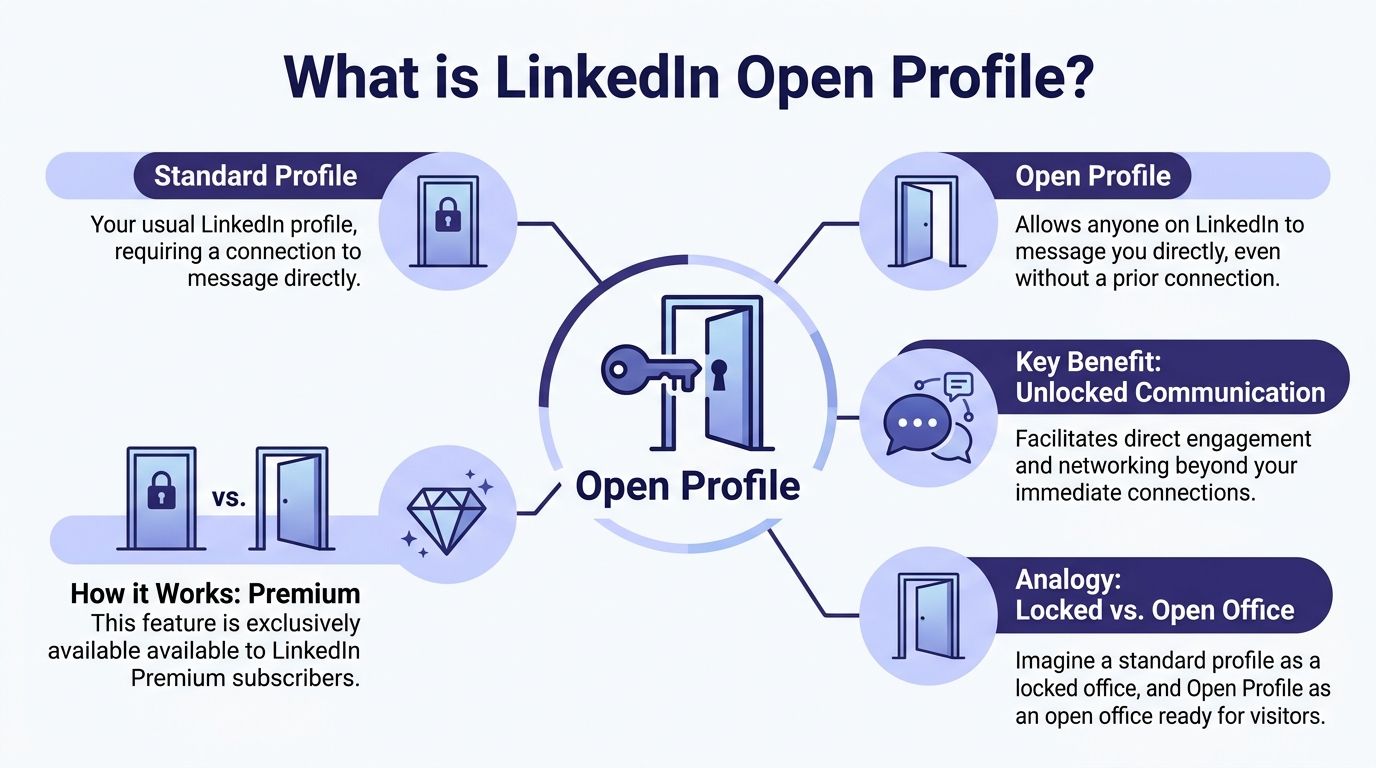
A standard LinkedIn profile is like a locked office door. You can knock by sending a connection request, or pay for access through InMail, but you usually cannot just walk in and talk.
An Open Profile is the unlocked version of that office door.
It is a Premium-only setting that lets any LinkedIn user send that profile a free direct message, even without a prior connection. Those messages go to the recipient’s Other inbox tab, and the recipient still controls whether to respond. The feature does not erase privacy settings. It only changes the messaging path.
Who enables it and who benefits
The receiver must have LinkedIn Premium and choose to enable Open Profile. The sender does not need Premium just to message that open profile.
That is why the feature matters far beyond the person enabling it. It creates a subset of LinkedIn users who are structurally easier to reach. In outreach terms, they are lower-friction prospects.
According to OutX’s breakdown of LinkedIn Open Profile, targeting Open Profiles can produce 25-40% higher response rates in cold outreach sequences because the visible badge signals receptivity to communication.
What the signal really means
The mechanics are simple. The signal is where the strategy lives.
Open Profile tells the market something important: “I am open to hearing from people outside my network.” That does not mean every message will be welcomed. It does mean the sender is no longer forcing the recipient through a connection-approval step before the conversation can begin.
For practitioners, that distinction matters in three ways:
- Faster first contact: You can test interest immediately instead of waiting for a request to sit pending.
- Lower acquisition cost: Free messaging can replace some paid InMail usage.
- Cleaner campaign design: You can reserve connection requests for people you want in the long-term network.
How to think about it operationally
Most basic explainers stop at the feature definition. That misses the full value.
Open Profile is best understood as a message delivery option inside your broader sequencing system. If you run outreach at volume, every prospect should be assigned a route:
- Open message first when direct access exists.
- Connection request when building the relationship matters.
- InMail when the account is high value and you need a stronger, more explicit reach-out.
Key takeaway: Open Profile does not replace outbound strategy. It improves route efficiency inside that strategy.
That is the practical answer to what is LinkedIn open profile. It is a premium setting on the receiver’s side, but for the sender it functions like an unlocked messaging channel.
Open Profile vs InMail vs Connection Requests
Most LinkedIn outreach mistakes come from using one contact method for every prospect. That is inefficient.
Each path sends a different signal to the recipient and creates a different cost structure for the sender. The comparison below is the practical version teams use when deciding how to allocate message volume.
LinkedIn Outreach Method Comparison
| Criterion | Open Profile Message | InMail Message | Connection Request |
|---|---|---|---|
| Access path | Direct message to a non-connection if the recipient has Open Profile enabled | Direct message to a non-connection using Premium credits | Request to connect first, then message after acceptance |
| Cost to sender | Free | Credit-based through Premium plans | Free to send, but costs network capacity and sequence time |
| Recipient location | Typically lands in the recipient’s Other inbox | Delivered through LinkedIn’s InMail system | Appears as an invitation |
| Best use case | High-volume outreach to reachable prospects | High-value accounts where direct reach is urgent | Building long-term network and warming future outreach |
| Speed to conversation | Immediate if the profile is open | Immediate if credits are available | Delayed until the request is accepted |
| Main trade-off | Audience is limited to people who enabled the feature | Credits are finite, so misuse gets expensive | Approval friction slows campaigns |
| Strategic meaning | “I can contact this person now” | “This prospect is worth spending budget on” | “I want access plus a network relationship” |
When Open Profile is the best choice
Use Open Profile messages when the goal is fast, cost-efficient first contact.
This is especially effective in outbound lanes where you need to test demand across a broad segment. Examples include recruiter sourcing in a tight niche, SDR campaigns to mid-market buyers, or founder-led outreach where conserving invites matters.
Open Profile also reduces waste. If someone is reachable without a connection request, you can preserve invitation capacity for higher-priority network building.
When InMail still makes sense
InMail remains useful when the account is valuable enough to justify paid access.
A senior buyer, a hard-to-reach executive, or a candidate with scarce skills might deserve a cleaner, more formal touch. In those cases, spending credits is rational because the target set is smaller and more important.
The common mistake is using InMail as a default. That turns paid messaging into a substitute for segmentation.
Why connection requests still matter
Connection requests are slower, but they build durable network assets.
If your sales motion depends on repeated touches, content visibility, or future referrals, a new connection has compounding value. The issue is not that requests are bad. The issue is treating them as the only route.
A mature outreach program usually uses all three methods. The difference between average teams and strong ones is routing discipline. They stop asking “What can we send?” and start asking “What channel does this prospect justify?”
The Strategic Benefits for Scaled Outreach
The business case for Open Profile has less to do with novelty and more to do with economics. If your team sends outbound at volume, every avoidable layer of friction costs time, credits, and account capacity.
Lower messaging cost
The first advantage is obvious. Open Profile messages are free to send to enabled profiles.
That means you can reserve paid InMail for prospects who need it. For agencies and internal teams managing multiple campaigns, even a modest shift away from credit-based messaging improves efficiency. Budget goes to harder-to-reach accounts instead of being wasted on people who were already messageable.
More outreach velocity
Open Profile also increases speed.
You are not waiting for connection approval before testing a first message. That shortens the path from list to reply, which matters when multiple account managers, SDRs, or recruiters are working the same quarter with the same headcount.
For teams that automate safely, this becomes even more important. A disciplined workflow like the one described in this guide to a safe LinkedIn automation workflow that reduces ban risk in 2026 works better when your sequence uses the lightest valid touch instead of forcing every prospect through the heaviest one.
Better odds with self-signaled prospects
People who publicly signal openness often behave differently from closed-off users.
A good parallel is LinkedIn’s #OpenToWork feature. It has been adopted by 28 million people, and profiles with that badge receive 21% more views from recruiters according to Writeful Copy’s LinkedIn stats reference. The useful lesson is not just the recruiting angle. It is that visible receptivity changes how people engage with profiles.
Open Profile creates a similar dynamic for messaging. It does not guarantee replies. It does improve the odds that your message reaches someone who has already lowered the barrier to contact.
Stronger multi-account efficiency
The final advantage shows up in scaled systems.
When teams spread activity across multiple LinkedIn accounts, the smartest campaigns assign easier contacts to the cheapest channel. Open Profile prospects fit that lane well. They are often ideal for the first wave of contact because they consume less scarce capacity.
Tip: In multi-account outreach, the biggest gains rarely come from writing more copy. They come from sending the right message through the right route.
Open Profile is valuable because it helps teams protect invites, conserve InMail, and keep campaigns moving without bloating operational risk.
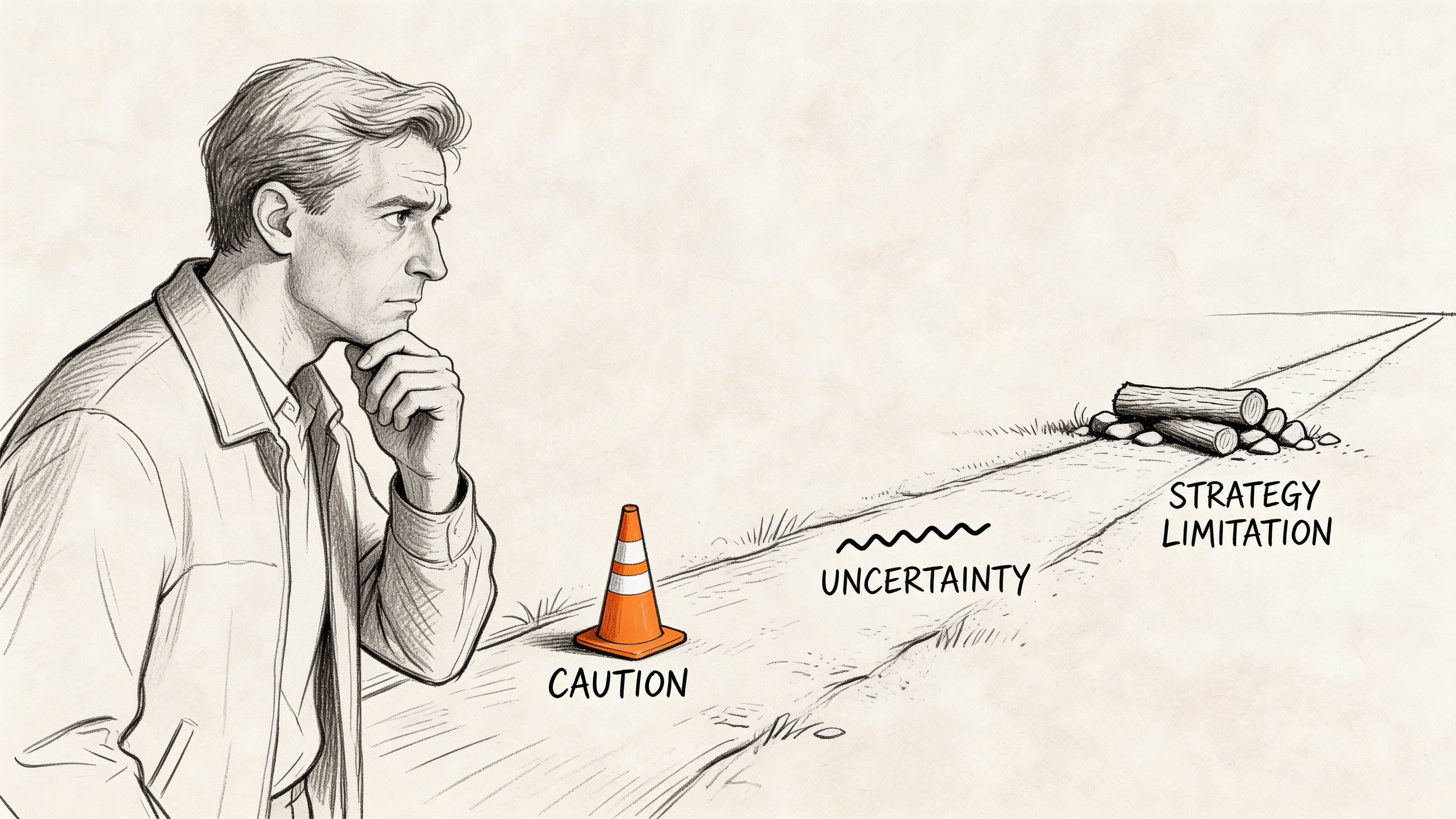
Understanding the Limitations and Risks
Open Profile is useful. It is not a magic bypass.
A lot of teams hear “free direct messages” and assume the feature can carry an entire outbound system. That is where trouble starts.
The reachable audience is smaller than it looks
You can only use Open Profile messaging when the recipient is both a Premium user and has the feature enabled.
So while it is an excellent segment, it is still a segment. You cannot build your entire list around it unless your market happens to over-index on Premium adoption and public accessibility.
That is why strong teams treat Open Profile as one lane in a broader routing model, not the whole road.
Messages can be easy to miss
Open Profile messages typically land in the Other inbox.
That means your note may not get the same attention as a standard ongoing conversation. The message path is open, but visibility is not guaranteed. If your opening line is weak, overly long, or generic, it can disappear without creating any useful signal.
Free messages still carry risk
The biggest misconception is that “free” means “safe.”
It does not. LinkedIn still evaluates account behavior as a whole. If an account sends too many low-quality messages, repeats the same template too aggressively, or layers automation on top of weak trust signals, restrictions are still possible. Account quality matters here. Teams scaling outbound should understand what a verified LinkedIn account means for outreach trust in 2026, because message strategy and account trust are connected. A good route does not save a poor account foundation.
What does not work
Some patterns consistently underperform:
- Generic intros: “Thought I’d connect” is wasted on a channel that already removes the connection step.
- Pitching too early: Open access does not mean immediate buying intent.
- Using one script everywhere: A message to an Open Profile should sound different from an InMail or post-acceptance follow-up.
Key takeaway: Open Profile reduces friction, not scrutiny. If the campaign looks spammy, LinkedIn can still treat it like spam.
Use the feature as a precision tool. The moment you treat it like unlimited inventory, response quality and account safety both get worse.
Actionable Use Cases for Modern Teams
The practical value of Open Profile shows up when you build it into workflows, not when you just recognize the badge.
Different teams should use it differently. The sequencing logic for an SDR team is not the same as the logic for an agency recruiter or a lead gen operator managing several client accounts.
For B2B sales teams
Start by separating list building from route assignment.
Use LinkedIn search or Sales Navigator to identify your target accounts and roles. Then split the list into at least three buckets: open profiles, standard profiles worth a connection request, and high-value closed profiles reserved for InMail or manual touches.
A workable sales motion often looks like this:
- Find reachable prospects first: Prioritize people who can be messaged without burning invites.
- Send a short first-touch message: Ask a relevant question or reference a problem the role likely owns.
- Move responders into a manual thread: Once the person answers, stop treating them like automation inventory.
- Use connection requests later if the conversation is real: Build the network after interest appears, not before.
This works especially well in Expandi, Dripify, and LinkedHelper setups where you want each account to use its available actions carefully.
For recruiters and talent teams
Recruiters often waste premium messaging on candidates who already signal openness.
Open Profile is useful for quick candidate checks, early interest tests, and sourcing in fast-moving hiring environments. It lets recruiters start with a direct, lightweight message rather than pushing every prospect into an invitation funnel.
A practical recruiter approach:
- Use Open Profile for first-pass outreach: Reserve costlier channels for talent that is harder to access.
- Keep the first message role-specific: Candidate outreach fails when it reads like a mass blast.
- Save your stronger persuasion for follow-up: The first reply is the milestone, not the booked call.
For agencies running client campaigns
Agencies benefit from Open Profile because it helps preserve scarce resources across many accounts and clients.
The key is campaign architecture. Do not let every client sequence use the same first step. Some verticals respond better to connection-first outreach. Others reward immediate messaging when the prospect already appears contact-friendly.
Open Profile segments are often ideal for fast validation. If a new offer, niche, or client positioning needs market feedback, start where access friction is lowest.
Expand the pool with adjacent open signals
Open Profile is not the only useful signal.
LinkedIn’s Creator Mode, launched in March 2021, has been activated by over 11 million members, and it changes the primary profile call-to-action from Connect to Follow, creating a similar “open” effect for content and engagement according to Elfsight’s LinkedIn statistics roundup. That does not make Creator Mode identical to Open Profile, but it does help identify users who are more public-facing and often more responsive to thoughtful outreach.
The best operators stack these signals. They look for people who are not just a fit, but visibly easier to engage.
Frequently Asked Questions About Open Profile
Do I need LinkedIn Premium to message an Open Profile
No. The recipient needs Premium and must have Open Profile enabled. The sender can message that profile without needing to connect first.
Is Open Profile the same as #OpenToWork
No.
#OpenToWork is a job-seeking signal. Open Profile is a messaging setting. Both indicate receptivity, but they serve different purposes.
Is Open Profile the same as Creator Mode
No.
Creator Mode changes profile presentation and emphasizes following and content visibility. Open Profile changes who can send direct messages without a prior connection.
Should I replace connection requests with Open Profile messages
Not entirely.
Connection requests still matter when your goal is long-term network growth, repeated touches, or relationship building. Open Profile is better when direct access is available and speed matters more than immediate network expansion.
Can Open Profile messages still get ignored
Yes.
Because these messages typically land in the Other inbox, some recipients may never see them quickly. That is why the first line and the reason for contact need to be sharp.
Can my account still get restricted if I use Open Profile a lot
Yes.
The feature lowers messaging friction, but it does not exempt your account from LinkedIn’s broader activity monitoring. High-volume, repetitive, low-quality behavior can still create problems.
How do I find Open Profiles at scale
Use your normal prospecting stack first, then classify reachable users during list review. Sales Navigator, manual badge checks, and enrichment workflows can all help identify profiles that are easier to approach directly.
What kind of message works best
Short, specific, and role-aware.
Do not waste the channel by sending a connection-style note or a giant pitch. Open Profile works best when the message feels like a natural direct conversation, not an automation artifact.
If your team wants to scale LinkedIn outreach without leaning on fragile main profiles, BIDVA provides real, ID-verified, warmed-up LinkedIn accounts built for safer outbound. They are especially useful for SDR teams, agencies, recruiters, and automation-heavy operators who need stronger trust, better deliverability, and full ownership of durable LinkedIn assets.